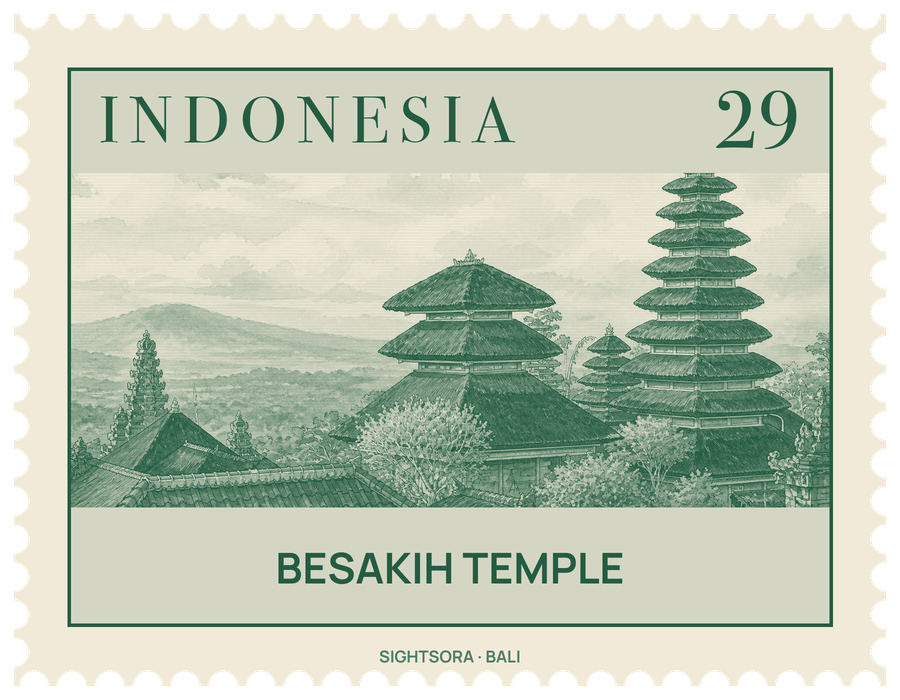
Besakih Temple is the holiest temple of Balinese Hinduism, and it is not one building but a complex of 23 related temples spread over parallel ridges. The whole complex is aligned on one axis, so that the climb through its six terraced levels and successive courtyards leads the worshipper upwards, towards the mountain held to be sacred.
The largest and most important of the temples is Pura Penataran Agung, the main sanctuary. A candi bentar, or split gateway, marks its entrance, and beyond it the Kori Agung gate opens into the second courtyard. At the ritual heart of the whole complex is the padmasana, a lotus throne dating from around the seventeenth century. Meru towers rise above the courtyards, and relief carvings can be found across the complex.
The site was almost certainly sacred long before Hinduism reached Bali: the stone foundations under Pura Penataran Agung and several of its neighbours look like megalithic stepped pyramids, a form at least 2,000 years old. Hindus were worshipping here by 1284, when the first Javanese conquerors settled on the island, and by the 15th century it had become a state temple of the Gelgel dynasty. In 1963 a series of eruptions of Mount Agung killed about 1,700 people, and the lava passed within metres of the complex; Balinese saw its survival as a miracle, a sign that the gods meant to show their power without destroying the temple.
Almost every shrine at Besakih celebrates a yearly anniversary, so the complex holds at least 70 festivals each year, following the 210-day Balinese Pawukon calendar. The largest gatherings come with major ceremonies such as Bhatara Turun Kabeh, when the temple is packed with worshippers and visitors.