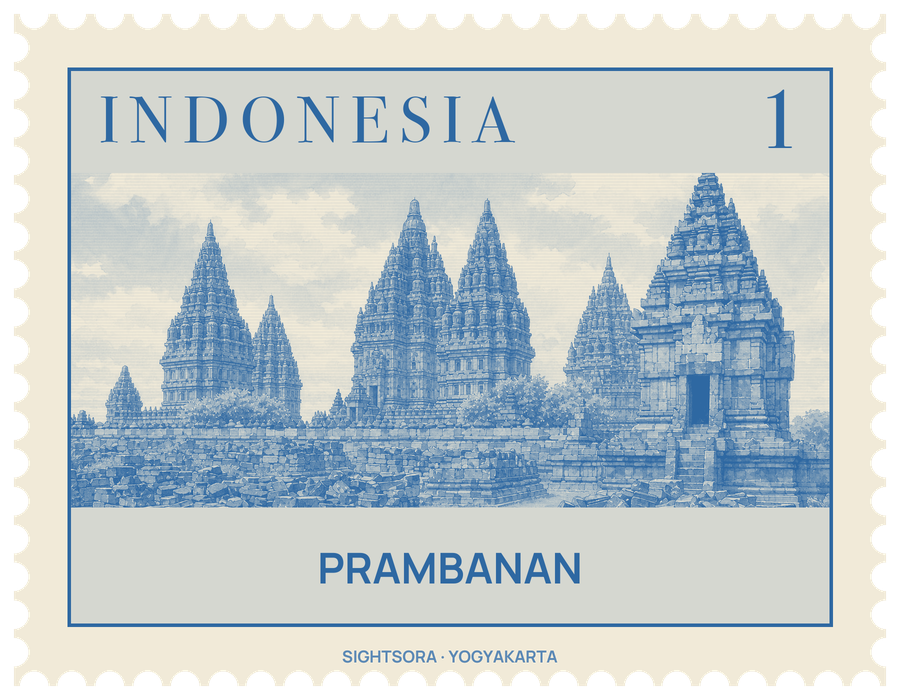
Built in the 9th century for the Trimūrti, the three forms of God as Brahma, Vishnu and Shiva, it is dominated by a central tower 47 metres high. An inscription of 856 CE describes the inauguration of a Shiva temple here, then called Shiva-grha, the House of Shiva; the work was probably begun by Rakai Pikatan, whose name was found painted in red on a finial of the main temple. The compound is a UNESCO World Heritage Site.
For roughly eighty years it served as the royal temple of the Mataram kingdom, and hundreds of brahmins are thought to have lived inside its outer wall. In the 10th century the court moved to East Java and the temples were left to decay; an earthquake in the 16th century brought them down. Local villagers explained the ruins with the legend of Rara Jonggrang, a princess who demanded a thousand temples built in a single night and was turned to stone when she tricked her suitor out of finishing them. Dutch rebuilding began in 1918, Sukarno inaugurated the reconstructed Shiva temple in 1953, and the Brahma and Vishnu temples followed between 1978 and 1991, all rebuilt from their original stones as far as possible.
The layout runs from an outer zone through a middle zone to a raised, walled inner court holding eight main shrines and eight small ones. In the middle zone, 224 small pervara shrines once stood in four concentric rows; only six have been rebuilt, and most of the rest survive as scattered stones and foundations. Facing the three great temples are three smaller ones for the gods' mounts: the bull Nandi, the swan Hamsa and the eagle Garuda. Only the Nandi temple still holds its statue, together with figures of the moon god Chandra and the sun god Surya on horse-drawn chariots.
The Shiva temple, 47 metres tall and 34 metres wide, is climbed from the east. Its central chamber holds a three-metre statue of Shiva Mahadeva standing on a lotus, with a crescent and skull in the crown and a third eye. Three side chambers house Agastya, Ganesha and Durga slaying the buffalo demon; local tradition calls this Durga the petrified Rara Jonggrang. The Vishnu temple to the north and the Brahma temple to the south, each 33 metres tall, have a single chamber with a statue of their god.
The galleries around the three main temples carry the reliefs most visitors come for. Starting at the east entrance and walking clockwise, the panels on the inner balustrade tell the Ramayana, from Ravana's abduction of Sita to Hanuman's monkey army coming to Rama's aid; the story begins on the Shiva temple and continues on the Brahma temple, while the Vishnu temple shows scenes of Krishna from the Bhagavata Purana. The lower outer walls repeat the so-called Prambanan panel: a lion in a niche between two wish-granting kalpataru trees. Across the Opak River on the west side, open-air and indoor stages were built for the Ramayana ballet.
The archaeological park around the compound also takes in the ruins of the Lumbung and Bubrah temples and reaches north to the Buddhist Sewu complex, which legend makes the unfinished thousandth temple. Further afield on the Prambanan Plain lie Plaosan, Kalasan, Sari and Sambisari, and the Ratu Boko site with its gates and bathing pools on a hill to the south.
Getting there
The compound lies just north of the highway that runs from Yogyakarta east to Surakarta. It is close to the Prambanan bus terminal, the end point of Trans Jogja line K3S, and Brambanan Station on the KAI Commuter Yogyakarta Line is about 750 metres to the southeast.