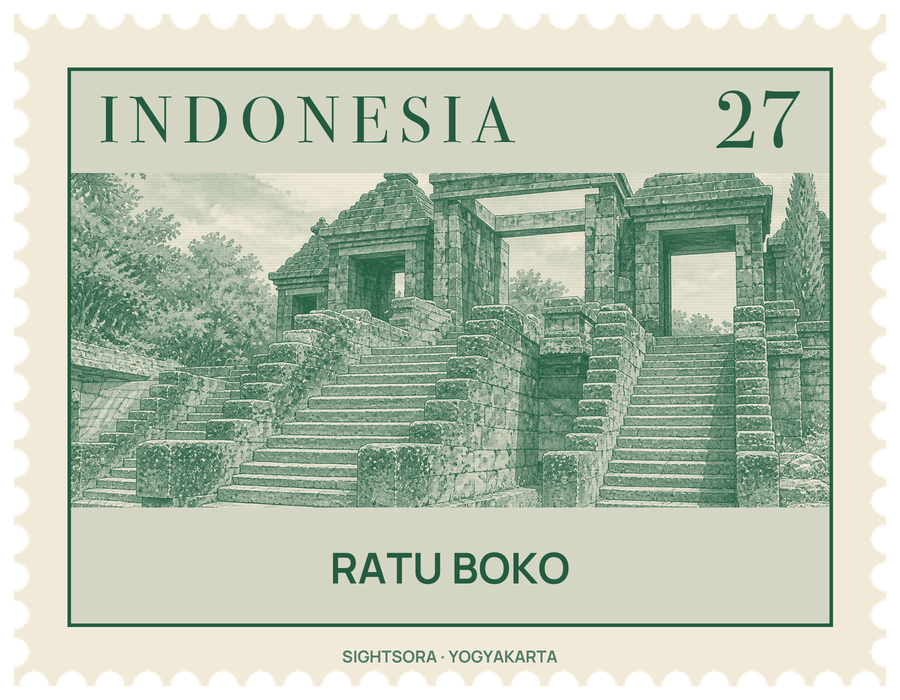
Most ancient sites of this period in Central Java are temples; Ratu Boko, by contrast, looks like a place where people lived, with remains of fortified walls and a dry moat, and it is often described as a palace. Its true function is still debated, and scholars have read it as a royal residence of the Mataram kingdom, a monastery or a retreat for rest and recreation. Inscriptions show it was occupied at least through the 8th and 9th centuries. From a small pavilion at the highest point of the site, 196 m above sea level, the view runs across to Prambanan with Mount Merapi behind.
The name comes from King Boko, the "Stork King" of the Roro Jonggrang folk tale, whom local people linked to the ruins. In that story his daughter, asked to marry the prince who had killed her father, demanded a thousand temples built in one night, and was turned to stone when she tricked him; tradition identifies her with the Durga statue in the Shiva temple at Prambanan. An inscription of 792 records that Rakai Panangkaran, a follower of Mahayana Buddhism, founded the Abhayagiri Vihāra, a monastery on the hilltop, and a Dhyani Buddha statue has been found here. Later the compound became a hilltop fortress; an inscription of 856 describes it as a defensive fort of stacked stones. Finds include Hindu statues of Durga, Ganesha and Garuda alongside Buddhist ones, and a golden plate inscribed to Rudra, another name of Shiva.
The visit begins at a massive two-level gateway onto the first of three terraces. A gate of the paduraksa type with three doors leads to the second terrace, and a second paduraksa gate, this one with five doors, opens onto the third and largest terrace. Near the gates stands Candi Batu Putih, a structure of white limestone, and on the north side of the plateau is Candi Pembakaran, a two-tiered base about 26x26 m with an empty square shaft in its upper terrace, probably a crematorium. Nearby, the paseban is a group of square stone platforms whose umpak, stones with holes for wooden columns, show that the halls above them were built of wood that has long since rotted away. The gate inscription bears the name of Rakai Panabwara, a descendant of Rakai Panangkaran, who carved it there to assert his claim to the palace.
In the south-east part of the site, the pendopo or audience hall is a square enclosure walled in andesite, with small paduraksa gates on three sides and a two-part stone platform inside. South of it is a small shrine of three miniature temples, fronted by a square basin of stone. To the east lies the area local people call the kaputren, or women's quarter: walled enclosures with gates and a gallery leading to several pools. One of them, Amerta Mantana, is sacred to Hindus, who draw its water for the Tawur Agung ceremony on the eve of Nyepi. From stone platforms east of the pools there is a view over a valley to Candi Barong, a Hindu temple complex on the slope opposite. North of the pendopo, apart from the rest, are two caves probably used for meditation: Gua Lanang, the Male Cave, with a pond and three carved figures in front, and below it Gua Wadon, the Female Cave.