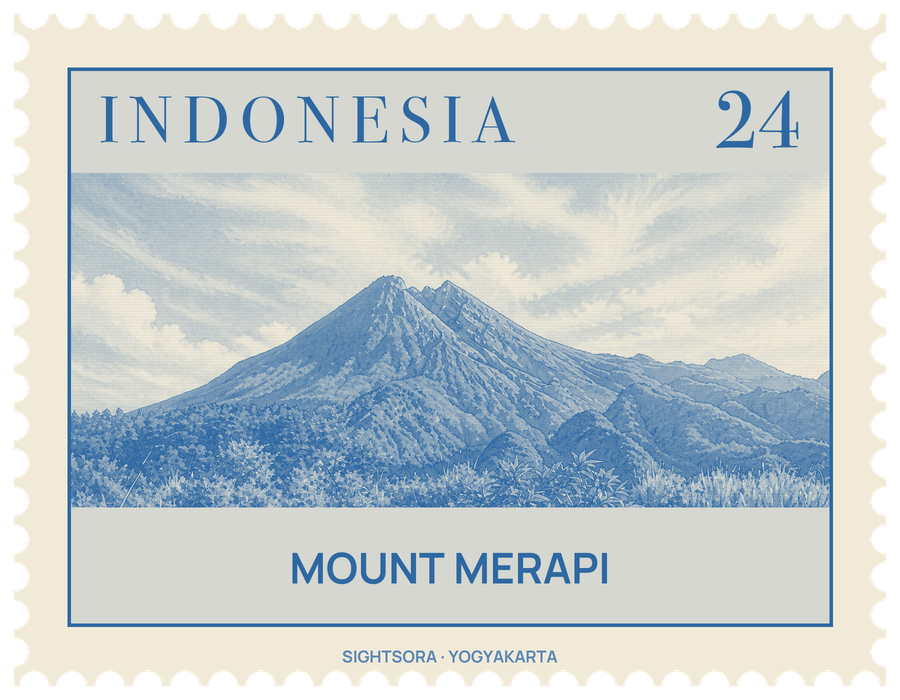
Its name joins Meru, "mountain", with the Javanese api, "fire". Thousands of people live on its flanks, in villages that reach as high as 1,700 metres. The eruption of October and November 2010 reshaped the peak and lowered it by 38 metres, to 2,930 metres.
Merapi is the youngest of a group of volcanoes in southern Java, and eruptions here go back about 400,000 years. Since about 10,000 years ago they have turned explosive, building domes of thick lava whose collapse sends down pyroclastic flows, called wedhus gembel, "shaggy goat", in Javanese. Large eruptions in 1006, 1786, 1822, 1872 and 1930 cost many lives, and because of the danger it poses to a crowded region, Merapi was named one of the Decade Volcanoes singled out for special study. Its monitoring goes back to 1924, with observation posts at Babadan, at Selo, on the saddle that links Merapi to Merbabu, and at Kaliurang. In 2004, 6,410 hectares around the mountain were declared a national park. The Merapi Museum Center, at kilometre 25.7 of Kaliurang Street in Pakem, Sleman, displays a replica of the mountain after the 2010 eruption.
For the Javanese living around it, Merapi is a mountain of spirits. Village stories tell how the gods moved a mountain to the centre of Java to balance the island and buried under it two armourers, Empu Rama and Empu Permadi, who refused to stop forging a sacred keris; their spirits are said to rule a palace inside the volcano, a spirit counterpart of the Yogyakarta Sultanate. For the Sultanate, the peak marks the northern end of a sacred axis that runs south past the Tugu Yogyakarta monument, along Malioboro street, through the Northern Alun-alun and the Keraton Yogyakarta, the sultan's palace, to the Southern Alun-alun and on to Parangkusumo beach on the Indian Ocean, linking the mountain's spirit, the Sultan and Nyi Roro Kidul, queen of the Southern Ocean.