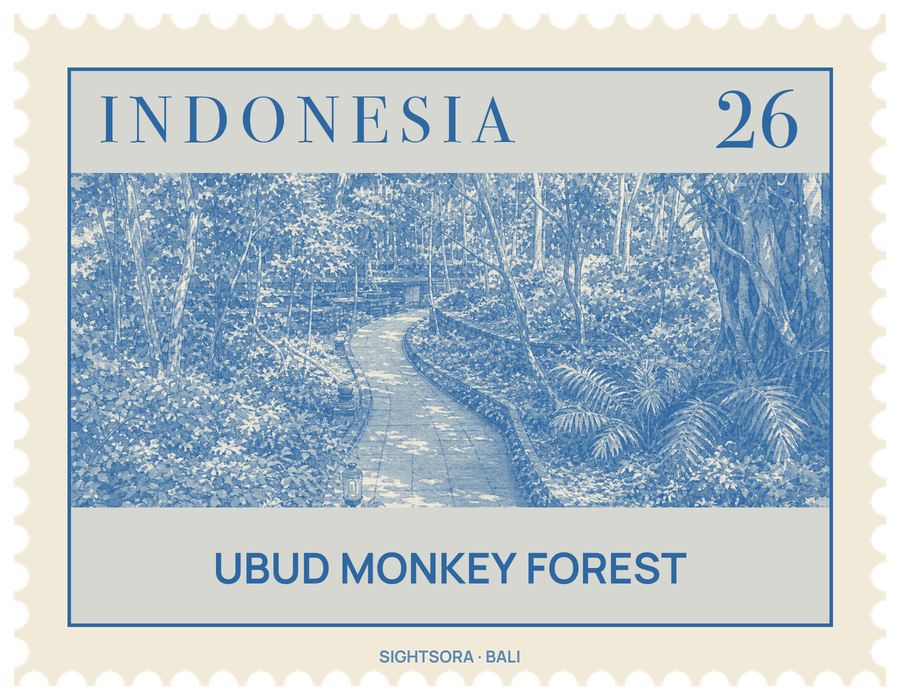
The sanctuary lies in the village of Padangtegal, which owns it, and covers about 10 hectares of forest with at least 115 species of trees. Local Balinese consider the monkeys sacred, and the sanctuary is both a nature reserve and a temple complex.
Three Hindu temples stand in the forest, all apparently built around 1350. Pura Dalem Agung Padangtegal, the Main Temple, lies in the south-west of the park and is devoted to Hyang Widhi in the form of Shiva. In the north-west, Pura Beji is a bathing temple at a holy spring, used for spiritual and physical cleansing before ceremonies. Pura Prajapati, in the north-east, sits beside a cemetery where the dead are buried temporarily until a mass cremation held once every five years.
The macaques live semi-wild in five groups, each holding its own territory: in front of the main temple, in the eastern and central parts of the park, in the area called Michelin, and around the cremation ground and cemetery. Park staff feed them sweet potatoes three times a day, and the monkeys also eat maize, coconut, cucumber, papaya leaf and other fruit grown locally. They are active by day, so visitors walking the paths can watch them grooming, fighting, mating and caring for their young at close quarters. The monkeys have lost their fear of people and will grab bags they think hold food, search pockets and even climb onto visitors; staff carry slingshots to deter aggressive animals.
The sanctuary describes its mission through the Hindu principle of tri hita karana, harmony between people, with nature and with God. It also conserves plants and animals used in Hindu rituals and serves as a field laboratory for research on the monkeys' social behaviour. A fenced enclosure keeps a small herd of Timor rusa deer, and the grounds also have a gallery and public hall, a canteen and an open stage.