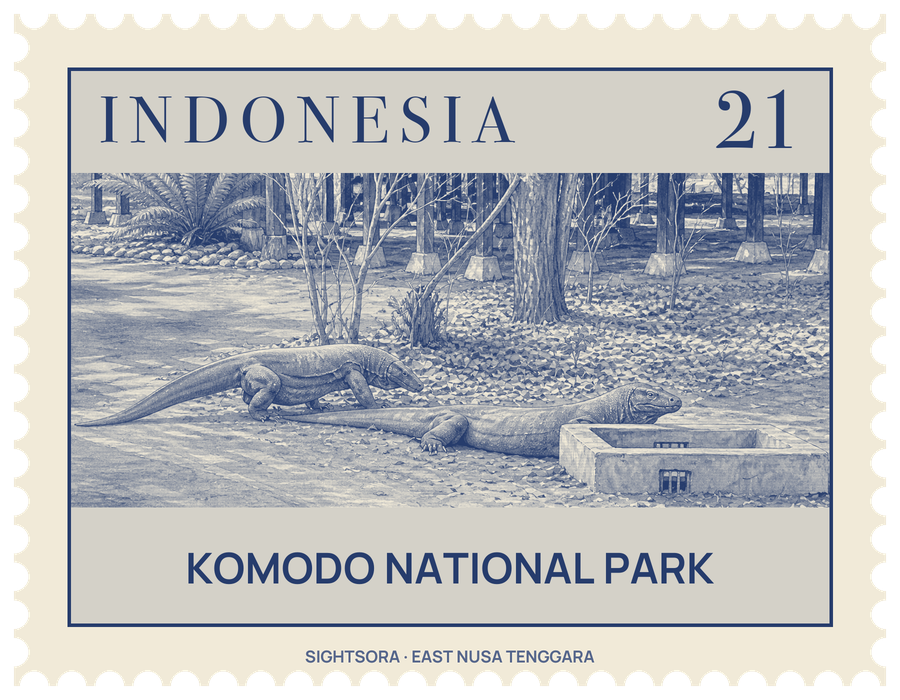
Its total area is 1,733 square kilometres, of which 603 are land. Its original purpose, when it was set up in 1980, was to protect the Komodo dragon; its aims later widened to the whole of the region's wildlife on land and at sea. In 1991 it was inscribed as a UNESCO World Heritage Site and named a Man and Biosphere Reserve.
The islands are volcanic, with rugged, rounded hills up to 735 metres high, and the climate is hot and dry. Savannah with lontar palms covers much of the land, giving way to deciduous forest, patches of cloud forest above about 500 metres and mangroves in the sheltered bays of the three main islands. This open, dry country suits the Komodo dragon, which lives only on Komodo, Rinca, Gili Motang, Gili Dasami and Flores and has died out on Padar. Males reach 3 metres in length, females 2 to 2.5 metres, and their main prey is the Timor rusa deer; the endemic Rinca rat, macaques, buffalo and wild boar also live here, along with birds such as the orange-footed scrubfowl and the critically endangered lesser sulphur-crested cockatoo.
Under water the park is far richer than on land. Fringing and patch reefs are most extensive along the north-east coast of Komodo, and the waters hold manta rays, eagle rays, whale sharks, ocean sunfish, pygmy seahorses, nudibranchs and blue-ringed octopuses, with dolphins, whales and dugongs in the surrounding seas. Diving is popular, and well-known sites include Batu Bolong, Tatawa Besar, Manta Alley, the Cauldron, Yellow Wall, and Castle Rock and Crystal Rock. Currents between the islands are strong, because water flows through the Sape Strait between the Pacific and the Indian Ocean as the tides change.
People live in the park as well, in four villages that predate it: Komodo, Rinca, Kerora and Papagaran. Most are fishermen whose families came from Bima, Manggarai, South Flores and South Sulawesi, among them Sama-Bajau and Bugis. Descendants of the island's original inhabitants, the Ata Modo, still live on Komodo; their traditions tie them closely to the dragon, which one of their myths calls their twin.
Getting there
The park's tourist trade is based in Labuan Bajo on Flores, and boats from its port run several kinds of trips through the park, from short daily snorkelling excursions to scuba liveaboards and tourist boats that take 4 days and 3 nights to sail from Lombok to Flores.