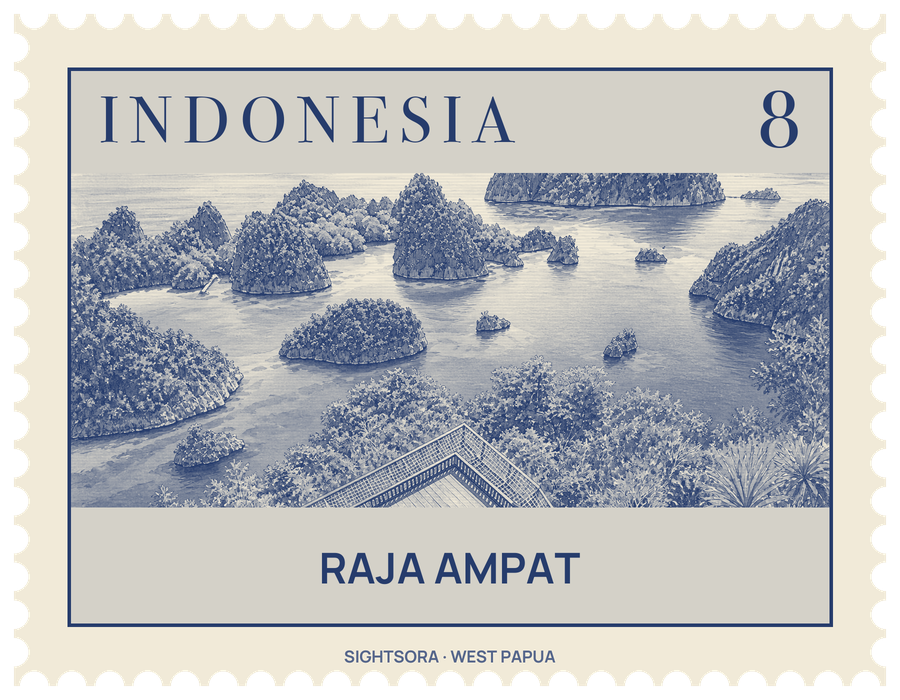
They gather around four main islands, Misool, Salawati, Batanta and Waigeo, plus the smaller Kofiau, just south of the equator. The waters lie within the Coral Triangle, and in 2025 UNESCO designated the islands a biosphere reserve.
Local mythology explains the name with a woman who found seven eggs: some hatched into kings who ruled these islands, one became a woman, one a spirit, and the last turned to stone and is still honoured as a king at Kali Raja on Waigeo. People reached the islands more than 50,000 years ago, and in 1526 a Portuguese crew under Jorge de Menezes came ashore. Islam arrived in the 15th century, and through close ties with the Sultanate of Tidore the islands came to be counted as part of its realm. Most islanders live from fishing, in small communities spread across the archipelago.
The reefs are what draw divers and researchers. Surveys have counted over 600 hard coral species and over 1,700 kinds of reef fish, on shallow and deeper reefs alike, from pygmy seahorses and cleaner shrimp to whale sharks. Dugongs, dolphins and several kinds of whale occur here, and on Waigeo villagers protect the nests of leatherback, olive ridley and hawksbill turtles. In the Misool area there are at least three ponds of harmless jellyfish.
On land, rainforest covers the islands. Waigeo, Gam and Batanta are the only home of two birds-of-paradise, the red bird-of-paradise and Wilson's bird-of-paradise. Raja Ampat Marine Recreation Park, designated in 2009, is made up of four separate marine areas, among them Mayalibit Bay in central Waigeo, the seas off southeastern Misool and the Sembilan Islands.