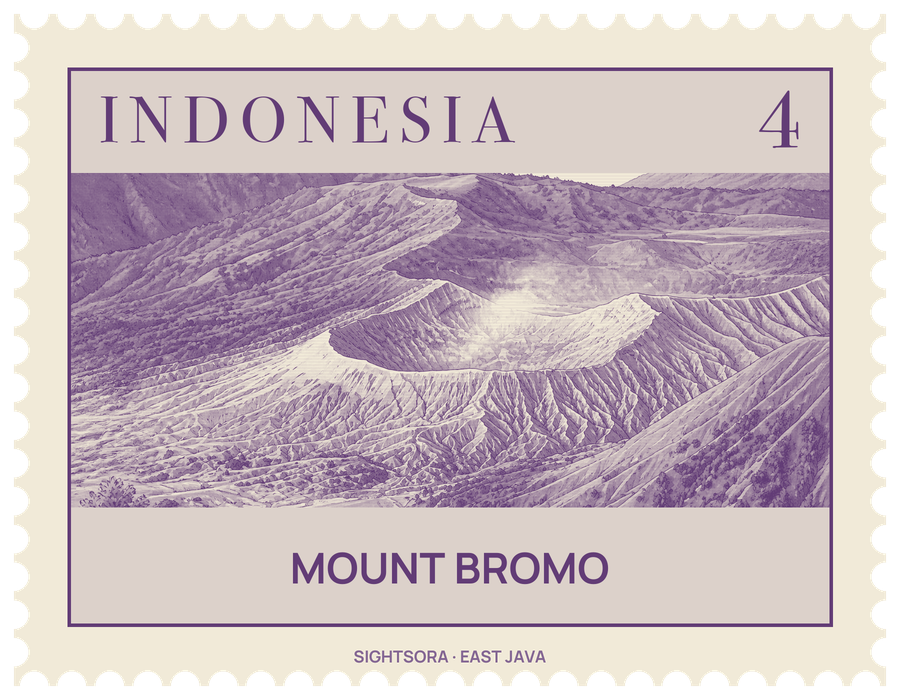
It lies within the Bromo Tengger Semeru National Park. Other summits of the massif stand higher, yet Bromo is the most active, and its name is the Javanese way of saying Brahma, the Hindu god of creation. An idol of Ganesha stands at the mouth of the crater and is worshipped by Javanese Hindus.
Seen from the most popular viewpoints along the northern rim, the steep, prominent cone of neighbouring Mount Batok stands in front of the flatter Bromo crater, and it is often taken for Bromo itself. The classic panorama is from Mount Penanjakan, 2,770 metres high, above the caldera.
Bromo is also a Hindu pilgrimage site for the Tenggerese people of the surrounding mountain villages, such as Ngadisari, Wonokitri and Ngadas. On the sand plain stands their temple, Pura Luhur Poten, built of natural black volcanic stone rather than the red brick of most Balinese temples, with its buildings and enclosures laid out in mandala zones. The temple organises the Yadnya Kasada ceremony, during which the Tenggerese climb the mountain and throw offerings of fruit, rice, vegetables, flowers and livestock into the crater for the mountain gods, a ritual rooted in a 15th-century legend.
Bromo erupts from time to time; an eruption in 2004 killed two people struck by rocks, and later episodes in 2010 and 2011 spread ash across the surrounding villages.
Getting there
Most visits start from the mountain village of Cemoro Lawang, from where the volcano is about 45 minutes away on foot; organised jeep tours also run from there, stopping at the Mount Penanjakan viewpoint, a walk of around two hours.