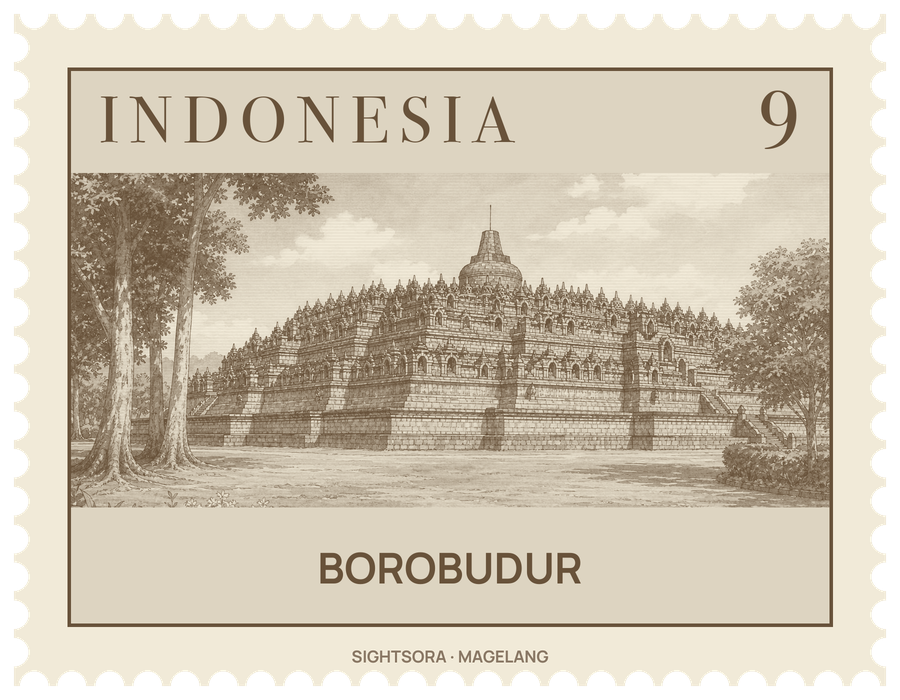
Raised under the Sailendra dynasty, it was abandoned centuries later and lay buried under volcanic ash and jungle until 1814, when Stamford Raffles, then running Java for the British, sent the Dutch engineer Hermann Cornelius to clear it. Together with the smaller Mendut and Pawon temples, which stand on a straight east–west line with it, it was listed by UNESCO in 1991 as the Borobudur Temple Compounds.
The monument is one huge stupa which, seen from above, forms a Buddhist mandala. It rises in nine platforms, the lower six square and the top three circular, on a base 123 metres on each side, and its central dome stands 35 metres above the ground. Some 55,000 cubic metres of stone were laid without mortar, locked together by knobs, indentations and dovetails, and the reliefs were carved in place once the structure was complete. Stairways in the middle of each side lead upward through arched gates crowned with Kala heads and flanked by makaras; the main entrance is on the east, where the first narrative reliefs begin.
The walls and balustrades of the first four galleries carry some 2,670 relief panels, 1,460 of them narrative, running for about 3,000 metres. Pilgrims read them by walking clockwise with the monument to their right. The first gallery tells the life of the Buddha from his descent from the Tushita heaven to his first sermon at Sarnath, alongside stories of his former lives; the upper galleries follow the youth Sudhana in his long search for Perfect Wisdom. Along the way the carvings show 8th-century Javanese life in detail: palaces, hermits in the forest, villages, markets, animals and a double outrigger ship.
Below the visible base lies a hidden foot, found by accident in 1885, with 160 panels showing deeds and their karmic consequences, from gossip and murder to charity and pilgrimage. The foot was encased again after it was photographed, and only its southeast corner is left open to view; the photographs are shown in the Karmawibhangga Museum a few hundred metres north of the temple. Nearby, the Samudra Raksa Museum holds a full-size replica of the Borobudur Ship, which sailed from Indonesia to Africa in 2004.
Higher up, the reliefs give way to plain circular terraces. The original 504 Buddha statues sat cross-legged in niches along the square platforms and inside the 72 perforated, bell-shaped stupas ringing the central dome; their hand gestures change with the direction they face. More than 300 of them are damaged, mostly headless, and a number of heads ended up in museums abroad.
The monument was first restored by Theodoor van Erp between 1907 and 1911, and again between 1975 and 1982 by the Indonesian government and UNESCO, when over one million stones were dismantled, catalogued and reset around a new drainage system. Since that restoration the monument has again served for worship and pilgrimage, and the Waisak ceremony walks from Mendut to Pawon and ends at Borobudur.