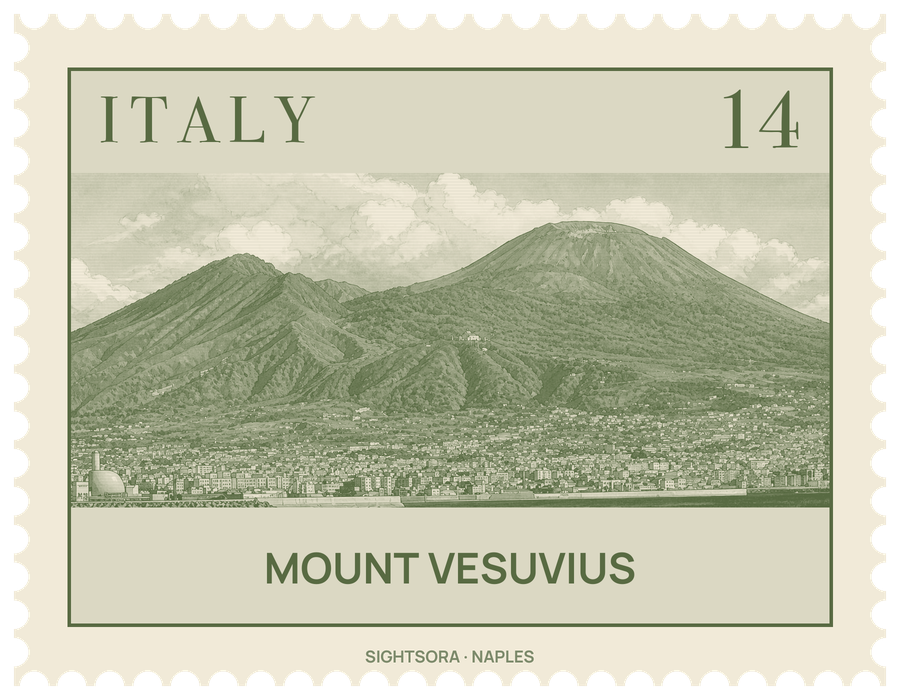
The summit of the cone stands 1,281 m above the sea, more than 400 m above the Atrio di Cavallo, the valley that separates it from the Somma ridge. Its lower slopes are covered in vineyards, with scrub and woodland higher up and bare tongues of old lava in between.
The volcano owes its fame to the eruption of AD 79, which buried the Roman towns of Pompeii, Herculaneum, Oplontis and Stabiae. A column of stones, ash and gas shot up to 33 km, pumice rained on Pompeii, and on the second day searing pyroclastic surges swept over both Pompeii and Herculaneum; the latter ended up under 23 metres of volcanic material. All that survives from an eyewitness is a pair of letters that Pliny the Younger wrote to the historian Tacitus, describing what he saw from Misenum across the bay and the death of his uncle, Pliny the Elder, who had sailed towards the danger with the fleet to rescue people on the coast.
The mountain has erupted many times since. Ash from the eruption of 472 drifted as far as Constantinople, and on 5 April 1906 an outburst left over 100 dead and so much damage in Naples that the funds set aside for the 1908 Summer Games went into rebuilding, and the Games moved to London. Vesuvius was active from 1913 to 1944, and the eruption of March 1944 wrecked dozens of B-25 bombers belonging to a United States Army Air Forces group based at an airfield near Terzigno, at the eastern foot of the volcano.
In Roman times people linked the mountain with Hercules, and household shrines in Pompeii show Vesuvius as a serpent. In 1880 a funicular was opened to carry visitors up the slope; it inspired the Neapolitan song "Funiculì, Funiculà" and survived until the eruption of March 1944 destroyed it.
The land around the volcano became a national park on 5 June 1995, and the summit is open to visitors. A road climbs to within 200 metres of the top, measured in height, and from there the only way up is on foot, along a path that spirals around the cone to the edge of the crater. A small network of other trails around the mountain is looked after by the park authorities, and the Osservatorio Vesuvio in Ercolano keeps watch on the volcano with seismic stations, satellite radar and gas sampling.