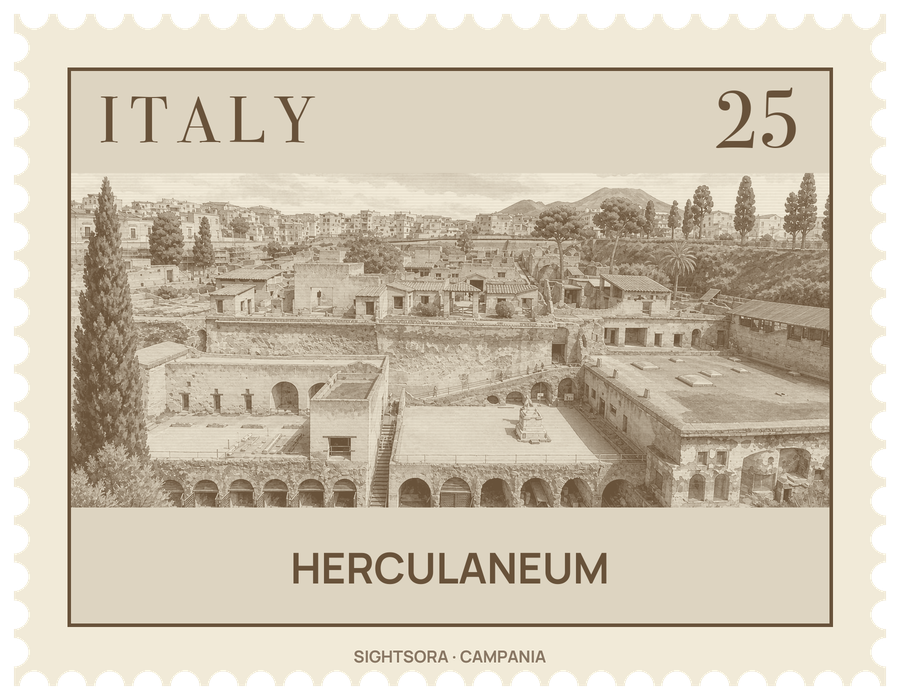
Because of the way it was buried, the town kept things that rarely survive elsewhere: carbonised wooden roofs, beds and doors, food and even papyrus. Smaller than Pompeii and home to around 5,000 people, it was a wealthier place, a retreat for the Roman elite with houses lavishly faced in coloured marble.
Herculaneum lay west of Vesuvius, so in the first phase of the eruption it received just a few centimetres of ash, though that was enough to drive most people out of the town. At 1 am the next day the eruption column collapsed, and a pyroclastic surge of ash and hot gas swept through the nearly empty streets at 160 km/h. Six flows and surges followed. In some quarters walls and columns were torn down; in others buildings, objects and victims were left almost intact under the deposit.
Discovery began in 1709 with a well, from whose bottom the Prince d'Elbeuf had a tunnel dug that struck the theatre and its sculptures. Regular excavation started in 1738 under Charles III of Spain, and the published plates of Le Antichità di Ercolano shaped early European Neoclassicism, putting Herculaneum motifs on fashionable furniture and teacups. Amedeo Maiuri uncovered about four hectares between 1927 and 1942, and this area forms the core of today's archaeological park. Much of the town, including the Forum, temples and theatre, remains buried, and because of slow ground movement in the Vesuvius area, some of the old streets sit up to 4 metres beneath sea level.
Visitors walk the grid of streets dividing the town into numbered blocks, or insulae, with each house given its own entrance number, such as the House of the Deer (Ins IV, 3). In the House of Argus, found in the late 1820s, a whole upper floor survived with a balcony over Cardo III. The House of the Alcove keeps its original mosaic and marble flooring, a richly frescoed dining room and the apsed alcove that names it. The Central Baths had separate sections for men and women. On the shore stood the Villa of the Papyri, built on four terraces, where workmen between 1752 and 1754 recovered blackened papyrus scrolls from its library; most are kept at the National Library in Naples.
The most moving part of the site is the ancient shoreline in front of the town walls. Until the 1980s it was thought that nearly everyone had escaped, but excavations from 1980 uncovered hundreds of skeletons on the beach and in the stone vaults known as the boat houses, where people waiting for rescue from the sea died in the heat of the first surge. Among them were the woman called the Ring Lady, after the rings still on her hands, and a soldier of officer rank, recognised by his elaborate belt and dagger, found next to a boat; his skeleton is shown in the boat pavilion. Many objects from Herculaneum are in the Naples National Archaeological Museum.