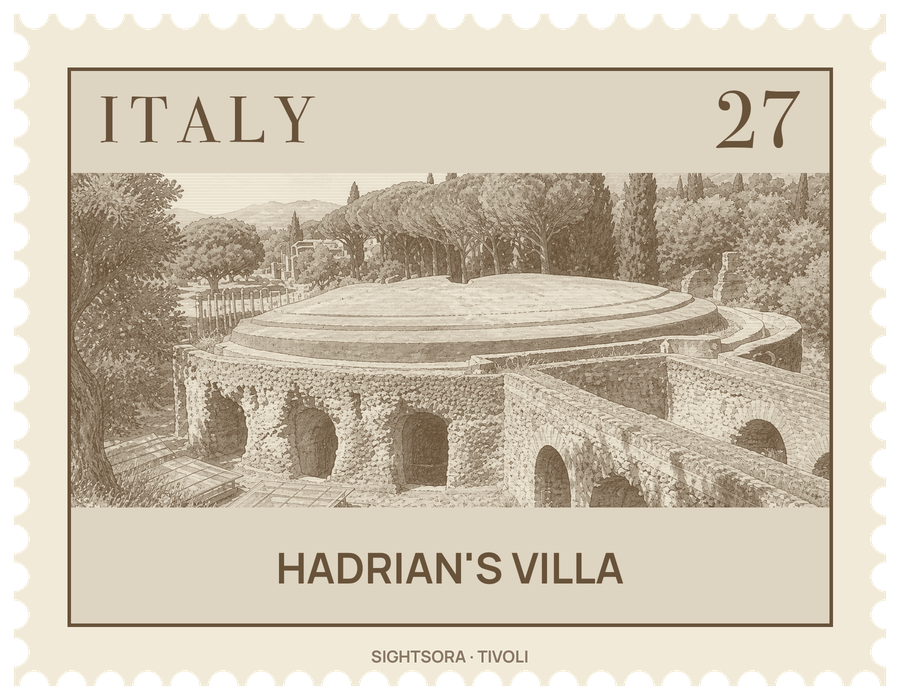
Work began at the end of 118 or early in 119, and the villa was greatly enlarged while Hadrian was travelling, so that he could return to finished buildings around 130. Its curved, concrete-vaulted halls later inspired Borromini, and UNESCO listed the site as World Heritage in 1999.
Hadrian named parts of the villa after famous places of the empire, among them the Lyceum, the Academy and Hades, and some buildings try to recreate landscapes he had seen. The Canopus, which takes its name from an Egyptian city and from the arm of the Nile running to it, is a long reflecting pool ending in a domed exedra that sheltered an outdoor dining couch; its sculptures included copies of the caryatids of the Erechtheion and a crocodile. The Poecile, modelled on the Stoa Poikile in Athens, is a huge raised garden with a pool 232 x 97 m; its 9 m central wall survives, and the double portico around it gave a covered walk of 430 m.
The so-called Maritime Theatre is not a theatre at all but a small house on an artificial island 25 m across, ringed by a circular moat and a portico on Ionic columns. Begun in 118 among the first buildings, it had its own atrium, library, dining room and small baths, and was reached by two wooden drawbridges. Nearby, the tall Hall of Philosophers has an apse with seven niches, probably for statues of the seven sages, and was lined with red porphyry. To the south and west, the Cento Camerelle, "100 rooms" stacked up to four floors, hold up the Poecile terrace and probably housed servants or guards.
The Piazza d'Oro, one of the richest parts of the villa, is a great peristyle garden with a central canal, entered through a vestibule under an "umbrella" dome; at its far end, rooms with concave and convex walls frame a nymphaeum where water once poured from seven niches. The Winter Palace rises on three levels with underfloor heating, around a courtyard of 40 columns enclosing a 28 m pool. Hadrian's own baths include the Heliocaminus, a room warmed by both the sun and a hypocaust, under a coffered dome with a central opening.
After Hadrian, later emperors used the villa from time to time and Diocletian restored it, but from the 4th century its statues and marble were carried away, and Cardinal Ippolito II d'Este, in the 16th century, removed much of what remained to decorate his Villa d'Este nearby. Finds from the villa ended up in museums far away: the Diana of Versailles is in the Louvre, the statue of Osiris-Antinous in the Vatican Museum, and the Dove Basin mosaic in the Capitoline Museums. Much of the site has never been excavated.