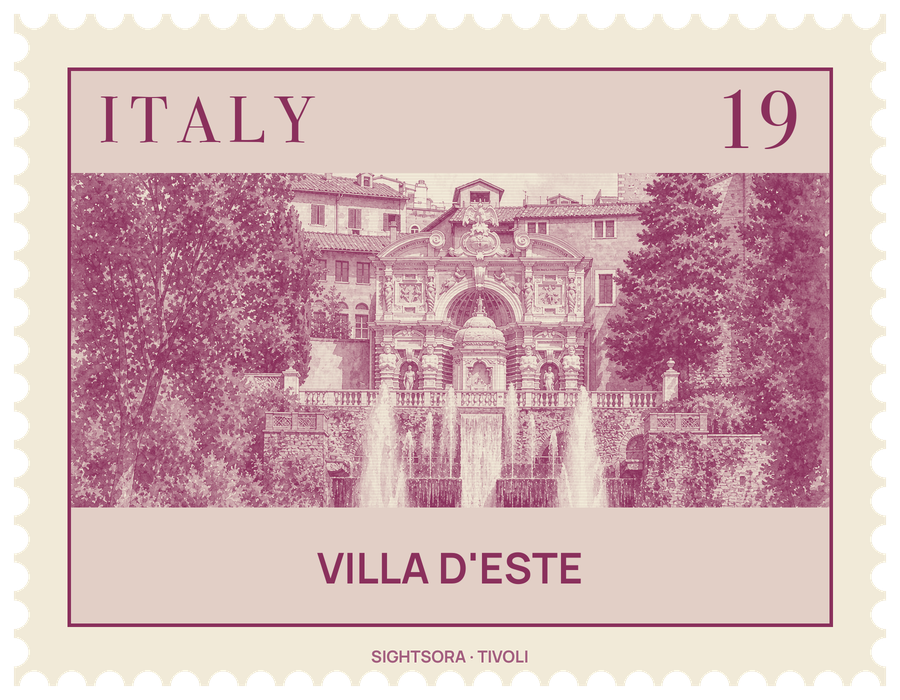
Water is drawn from the Aniene river, partly diverted through the town. The villa is an Italian state museum and has been on the UNESCO World Heritage list since 2001.
Cardinal Ippolito II d'Este, a son of the Duke of Ferrara and a grandson of Lucrezia Borgia, was made Governor of Tivoli in 1549 and took over the governor's residence, a former Benedictine convent with a wide view towards Hadrian's Villa. He hired the classical scholar Pirro Ligorio, who had studied Hadrian's Villa, to design a villa and garden to outdo the Romans, and took marble and statues from the ancient ruins. Work began in July 1560: whole streets and houses were cleared, earth was moved to build terraces, and the river was channelled into the site. Ippolito, five times a candidate for the papacy and never elected, died in Rome in December 1572.
Today's entrance is a doorway on Piazza Trento beside the Santa Maria Maggiore church, and from it visitors pass through rooms painted in the 1560s and 1570s by teams under Girolamo Muziano, Livio Agresti and Federico Zuccari. The courtyard, built on the old cloister, keeps the Fountain of Venus, the one fountain in the villa still in its original form. On the lower floor, a corridor whose vault is covered with mosaic birds on a pergola links themed halls; the Hall of the Fountain, where the cardinal received guests coming up from the garden, has a wall fountain encrusted with glass, shells and coloured ceramics under a ceiling fresco of the gods of Olympus.
From the long Vialone terrace, 200 metres from end to end, paths and stairways drop through the garden. The Oval Fountain, Ligorio's water theatre of 1565–1570, spills from a great basin beneath an artificial mountain standing for the hills around Tivoli; from it the Hundred Fountains, in reality nearly three hundred spouts shaped as eagles, lilies, boats and obelisks, run along three stacked channels to the Rometta, a miniature of ancient Rome. On the central axis, four sculpted dragons spout water around a tall vertical jet in the Fountain of the Dragons, altered for the visit of Pope Gregory XIII in 1572, whose arms included a dragon.
Lower down, the Fountain of the Organ played music by water power from 1571, so convincingly that Pope Gregory asked to look inside it for a hidden player; after centuries out of use, its organ was made to play again in 2003, now with 144 pipes. Beneath it, the Fountain of Neptune, built in the 1930s from the remains of a Bernini cascade, sends up powerful jets at the head of three fishponds. At the Fountain of the Owl, twenty bronze birds worked by water and air once sang until a mechanical owl appeared; parts of the old mechanism found during work in 2001–02 allowed it to be rebuilt. At the bottom, a ring of cypresses, two of them original, and the many-breasted Diana of Ephesus by Gillis van den Vliete close the garden; Franz Liszt, who came here several times between 1865 and 1885, wrote piano pieces inspired by its cypresses and fountains.
Getting there
Blue Cotral regional buses for Tivoli along the Via Prenestina depart from the terminal beside the Ponte Mammolo stop of metro line B; the Largo Nazioni Unite stop is about 100 m from the villa's entrance. FL2 urban trains also run from Tiburtina station to Tivoli station; from there local CAT bus 1 or 4 reaches the Piazza Garibaldi stop, on the town's main square facing the villa.