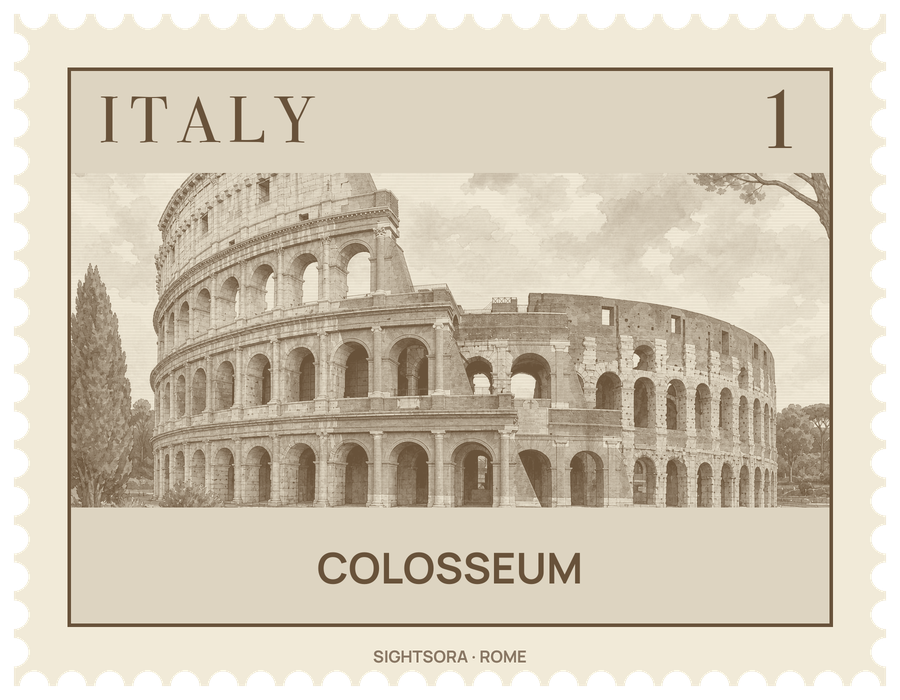
It was begun under the Emperor Vespasian and finished under his son Titus in AD 80, and his younger son Domitian altered it further; because all three belonged to the Flavian family, later scholars called it the Flavian Amphitheatre. The popular name probably comes from the colossal bronze statue of Nero that stood beside it. For centuries it held tens of thousands of spectators for gladiator fights, animal hunts, executions and other public shows.
Vespasian built it on the site of the lake in Nero's Domus Aurea, the palace grounds Nero had taken over after the Great Fire of 64 AD, which gave a piece of the city back to the people. An inscription records that the work was paid for with Vespasian's share of the treasure carried off from the Jewish Temple after the Siege of Jerusalem. Over 9,000 wild animals are said to have died in the opening games. Fighting between gladiators is last mentioned around 435, though animal hunts went on until at least 523.
The building stands free on flat ground, its plan 189 metres long and 156 metres wide. The surviving stretch of the outer façade, on the north side, shows three storeys of arches framed by Doric, Ionic and Corinthian half-columns under a tall attic; the brick buttresses at each end were added in the early 19th century, and the rest of today's exterior is in fact the old inner wall. Holes where iron clamps were hacked out of the travertine still pit the stone. Along the top, 240 stone brackets once held the poles of the velarium, a canvas awning worked by sailors from the fleet at Misenum.
Crowds were handled much as in a modern stadium. Eighty ground-level entrances were numbered, as were the staircases, spectators carried numbered pottery tokens, and passages called vomitoria let a full house leave in minutes; entrances XXIII to LIIII survive. Seating followed Roman rank: boxes for the Emperor and the Vestal Virgins at the north and south ends, a podium for senators, whose names can still be read carved into the stone, then knights, citizens and, at the very top, a gallery Domitian added for the poor, slaves and women.
Little of the wooden, sand-covered arena floor is left, so visitors look straight down into the hypogeum, the two-level warren of tunnels and cages Domitian added beneath it. Gladiators and animals waited here, and lifts and pulleys raised animals and scenery through eighty shafts into the arena; tunnels led to the Ludus Magnus, the gladiator school just to the east whose remains are still there. After the games ended the building became housing, workshops, a Frangipani fortress and a quarry, and an earthquake in 1349 brought down the outer south side. In 1749 Pope Benedict XIV banned quarrying and dedicated it to the Passion of Christ, and once a year a torchlit Way of the Cross procession led by the Pope sets out from the area around it.