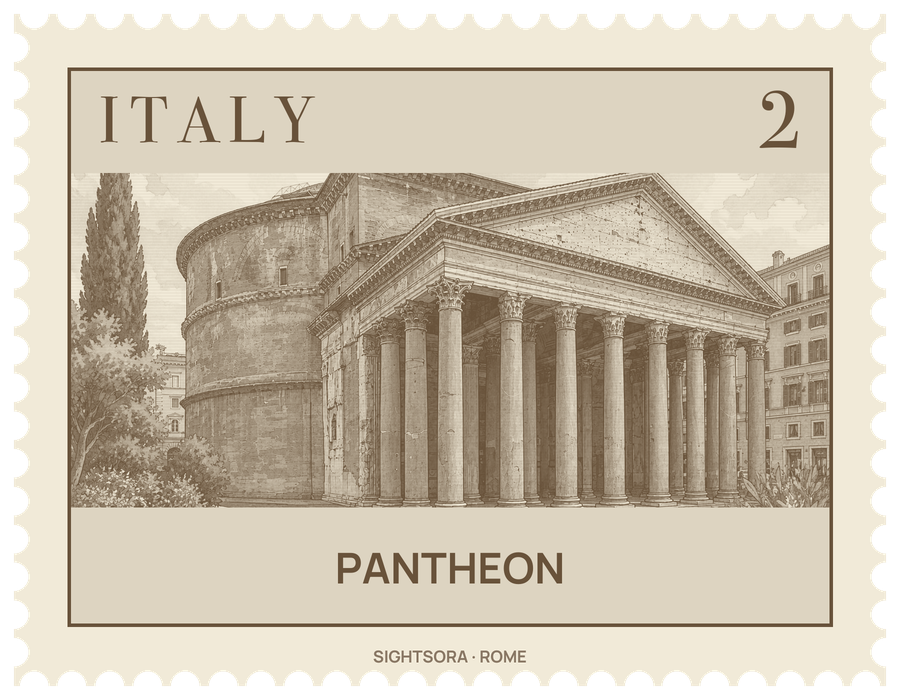
The present building replaced a temple put up by Marcus Vipsanius Agrippa in the reign of Augustus; after fires destroyed the earlier structure, it was completed under the emperor Hadrian and probably dedicated around AD 126. Since 609 it has been a Catholic church, Santa Maria ad Martyres, also known as Santa Maria Rotonda, and its unbroken use is the main reason it has survived so well.
The inscription across the front still names Agrippa, son of Lucius, consul for the third time, because Hadrian reused the text from the earlier temple; this is why the building was long thought to be Agrippa's own. Its name, from the Greek for "of all the gods", puzzled even the Roman senator Cassius Dio, who guessed it came either from the many statues of gods inside or from the dome's likeness to the heavens. In 609 the Byzantine emperor Phocas handed the building to Pope Boniface IV, who consecrated it to Mary and the martyrs, and a Byzantine icon of the Virgin and Child linked to that gift hangs in the apse above the high altar.
The portico stands on sixteen columns, eight across the front and two groups of four behind, each shaft 11.9 metres tall and cut from granite quarried in Egypt, grey from Mons Claudianus and pink from Aswan. They travelled by sledge, Nile barge, sea and Tiber barge before being rolled the last stretch to the site. The great bronze doors into the rotunda, more than 7.5 metres high, are the original Roman ones. On the portico, the capital of one column carries the bee of the Barberini family: Pope Urban VIII replaced the column, and he also stripped the portico's bronze roof trusses, mostly to cast cannon, prompting the Roman jibe that what the barbarians did not do, the Barberini did.
Inside, the height from floor to oculus equals the diameter of the room, about 43 metres, so the whole space would fit inside a cube. The dome is laid out in five rings of 28 coffers, and its concrete gets lighter towards the top, from travertine at the base through terracotta to tufa and pumice around the oculus, while the shell thins from 6.4 metres to 1.2 metres. Rain falls straight in through the opening, and the floor slopes gently to drains. The light from the oculus moves slowly around the walls through the day, and at Pentecost firefighters throw red rose petals down through the oculus.
Around the walls, chapels and niches hold a long sequence of tombs and works of art. The artist Raphael lies here in a sarcophagus given by Pope Gregory XVI, with Pietro Bembo's Latin epitaph and, behind it, the Madonna del Sasso that Raphael commissioned from Lorenzetto. Other burials include the architect Baldassare Peruzzi, the composer Arcangelo Corelli and the painter Annibale Carracci. Two kings of Italy, Vittorio Emanuele II and Umberto I, lie in chapels of their own, Umberto beside his queen, Margherita. Melozzo da Forlì is credited with the Annunciation fresco in the first chapel on the right. As the building is a working church, visitors are asked to behave with due respect.