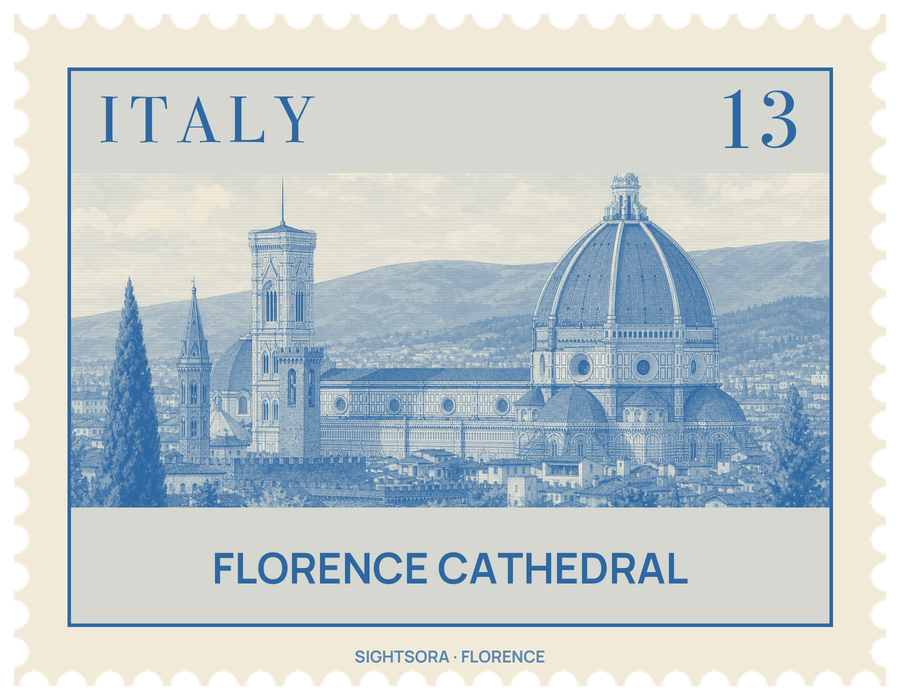
Its walls are dressed in bands of white, green and red marble brought from Carrara, Prato and Siena, and it forms one group with the Baptistery of San Giovanni and Giotto's Campanile; all three belong to the UNESCO World Heritage Site of the historic centre of Florence. It is the seat of the Archbishop of Florence, and the plan of its three apses was meant to recall a flower, a nod to the city's name.
Arnolfo di Cambio's design was approved in 1294, and building began on 9 September 1296 on the site of the older cathedral of Santa Reparata. After Arnolfo's death in 1302 work slowed for decades; the wool merchants' guild, the Arte della Lana, took charge in 1331, and Giotto, appointed in 1334, put his energy into the bell tower. The nave was done by 1380, but the dome was still missing when the Arte della Lana called a competition for it in 1418, won by Brunelleschi over Lorenzo Ghiberti. Pope Eugene IV consecrated the church on 25 March 1436, and the gilt copper ball that Verrocchio set on the lantern in 1469 marked the end of the building work.
The dome was raised between 1420 and 1436 without the usual wooden centring. Brunelleschi built two brick shells, one inside the other, bound by rings of sandstone beams and iron, and laid the bricks in a herringbone pattern so each fresh course leaned on the ribs at the corners. To lift some 37,000 tons of material, including more than four million bricks, he designed his own hoisting machines. His wooden and brick model of the dome survives in the Museo dell'Opera del Duomo behind the cathedral.
The marble façade is much younger than the rest. The medieval front was left half-built and pulled down in 1587–1588, and the bare wall waited until Emilio De Fabris won a competition in 1871; his neo-Gothic design went up between 1876 and 1887. Its three bronze doors, made between 1899 and 1903, show scenes from the life of the Madonna, with mosaics by Niccolò Barabino in the lunettes and the twelve Apostles in niches along the top.
The Gothic interior feels wide and spare. Above the main door, a clock painted by Paolo Uccello in 1443 runs on a single hand through the 24 hours of "Italian time", which ended each day at sunset. Uccello also painted the green-toned fresco of the mercenary captain Sir John Hawkwood, and a fresco by Domenico di Michelino shows Dante before the city of Florence, with the three realms of the Divine Comedy around him. Inside the dome, Giorgio Vasari and Federico Zuccari covered about 3,600 square metres with The Last Judgment between 1572 and 1579. There are 44 stained-glass windows, designed by artists such as Donatello, Ghiberti, Uccello and Andrea del Castagno.
Excavations between 1965 and 1974 opened the ground beneath the floor, revealing Roman houses, an early Christian pavement and the ruins of Santa Reparata; the part of the crypt open to visitors holds the plain tomb of Brunelleschi near the entrance. Every 21 June a re-enactment revives the meridian line that the astronomer Paolo dal Pozzo Toscanelli laid out in 1475 by cutting a small hole high in the dome, over ninety metres above the pavement. The cathedral chapter asks that visitors wear clothing suited to a place of worship, and people with limited mobility can use the Porta dei Canonici on the right-hand side.