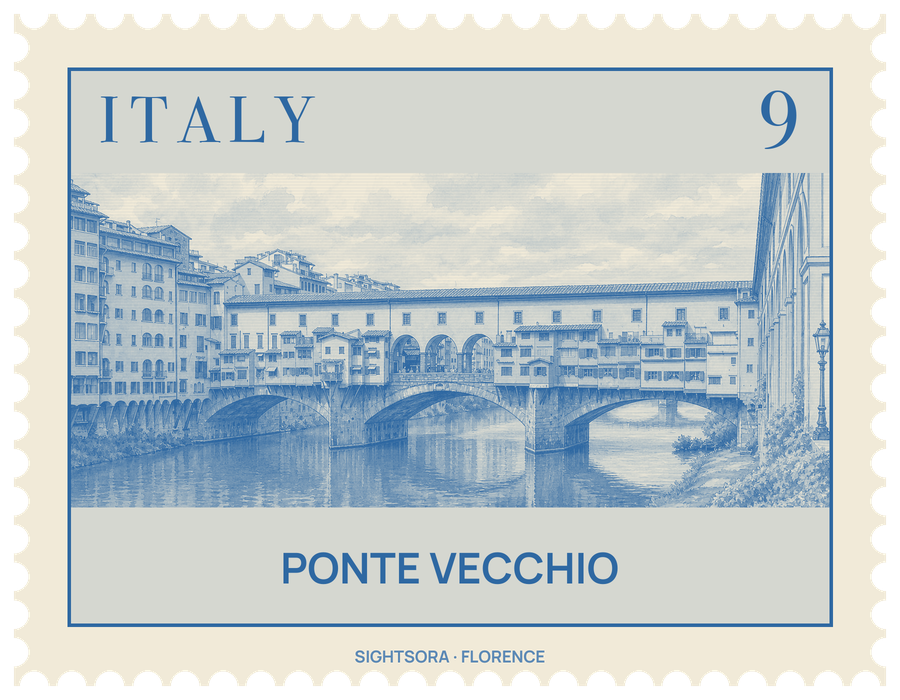
Closed to cars, it joins Via Por Santa Maria on the north bank to Via de' Guicciardini on the south, so a walk from Piazza del Duomo and Piazza della Signoria to the Oltrarno district, with Santo Spirito and Palazzo Pitti, crosses it. The nearest bridges on either side are the Ponte alle Grazie and the Ponte Santa Trinita.
A crossing is thought to have stood here since Roman times, when the via Cassia met the river at this spot, with stone piers carrying a wooden deck. The bridge is first mentioned in a document of 996; a flood destroyed it in 1117 and it was rebuilt in stone, then another flood in 1333 left only two central piers, and the present bridge went up in 1345. Giorgio Vasari credited the design to Taddeo Gaddi, while modern historians have suggested Neri di Fioravanti as the builder. It got its name when the Ponte alla Carraia was put up nearby in 1218 and was called the new bridge in contrast.
The central arch spans 30 metres and the two side arches 27 metres each, and their low curve needed fewer piers than a round Roman arch, which made the river easier to navigate and the bridge easier for carts. At the middle the shops part to leave an open piazza, which Leon Battista Alberti counted among the city's ornaments; in a small loggia at the central opening a worn stone records in verse the flood of 1333 and the rebuilding ten years later. The Torre dei Mannelli guards the southeast corner, and on the eastern side a fountain carries a bronze bust of Benvenuto Cellini by Raffaello Romanelli, commissioned by the bridge's goldsmiths in 1900.
The shops were first held by butchers, tanners and farmers; butchers had monopolised them from 1442 until a decree of 1565 banned them and reserved the bridge for goldsmiths and jewellers, and jewellers, art dealers and souvenir sellers fill the shops today. Seen from upriver, the back rooms jutting out behind the shops date from the seventeenth century. Also in 1565, Cosimo I de' Medici had Vasari build the Vasari Corridor between the Palazzo Vecchio and the Palazzo Pitti, and part of it runs along the top of the bridge.
At the entrance to the bridge, a stone carrying lines from Dante marks where Buondelmonte de' Buondelmonti was killed by the Amidei clan in 1215, the murder that set off the street fighting between Guelfs and Ghibellines. On 4 August 1944, as the German army retreated before the British 8th Army, every other bridge in Florence was destroyed but the Ponte Vecchio was spared; the buildings at both ends were demolished to block it, and have since been rebuilt. The bridge was badly damaged again in the Arno flood of 1966.