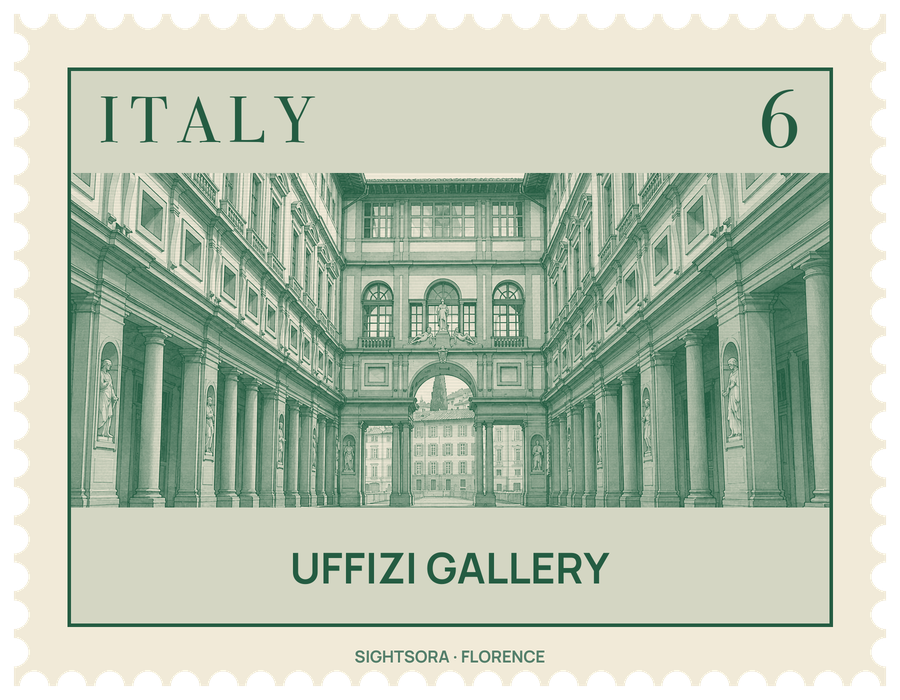
The name simply means "offices": Cosimo I de' Medici wanted the city's committees, agencies and guilds gathered in one place. Alfonso Parigi and Bernardo Buontalenti carried on the work, which was finished in 1581. Today the gallery forms part of the Gallerie degli Uffizi together with Palazzo Pitti and the Giardino di Boboli.
The building is as much a sight as its contents. Its courtyard is a long, narrow street-like space that opens at the far end onto the Arno through a Doric screen, and Vasari stressed its length with unbroken cornices along both façades and three continuous steps along the front. In the 19th century the niches in the piers of the Loggiato were filled with statues of famous artists.
The collection grew from the Medici's own. At first the top floor served the Medici and their visitors as a private gallery, holding their Roman sculpture, and Grand Duke Francesco I had Buontalenti design the Tribuna, an octagonal room finished in 1584 to show a set of masterpieces and jewels together, which became a famous stop on the Grand Tour. When the Medici line ended, the last heiress, Anna Maria Luisa, gave the collections to Florence through the Patto di famiglia, the family pact. The gallery could be visited on request from the sixteenth century, opened officially to the public in 1769 and became a museum in 1865.
The paintings range from the 13th to the 18th century. Among the best-known works are Cimabue's Santa Trinita Maestà and Giotto's Ognissanti Madonna, Paolo Uccello's Battle of San Romano, Piero della Francesca's portraits of Federico da Montefeltro and Battista Sforza, and Botticelli's Primavera and Birth of Venus. Leonardo da Vinci's Annunciation, Michelangelo's Doni Tondo, Raphael's Madonna of the Goldfinch, Titian's Venus of Urbino and Parmigianino's Madonna with the Long Neck hang here, as do Caravaggio's Bacchus and Medusa and Artemisia Gentileschi's Judith and Holofernes. Ancient sculpture includes the Venus de' Medici, the Arrotino and the Two Wrestlers.
The gallery has had its share of damage. The Arno flood of 1966 hit Florence's collections, the Uffizi among them, and on 27 May 1993 a Mafia car bomb in Via dei Georgofili killed five people, destroyed five works of art and damaged the Niobe room, which has since been restored.