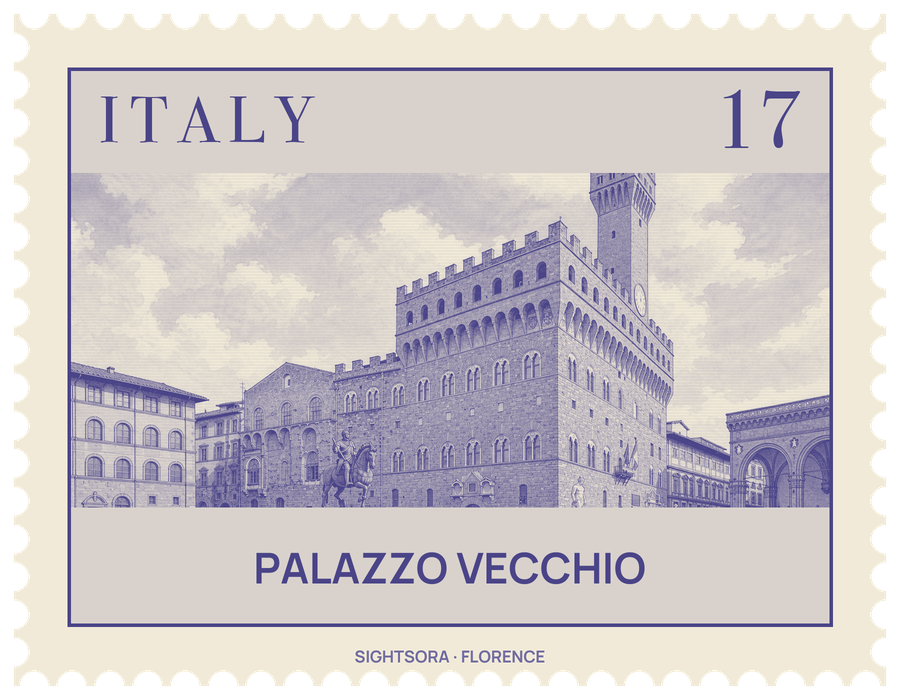
It went up between the end of the 13th and the start of the 14th century to house the Priori delle Arti and the Gonfaloniere di Giustizia, the city's highest government, and for over seven centuries it has stood, in the museum's words, as the symbol of civil power in Florence. It still is the town hall: the mayor has worked here since 1872 and the City Council meets here, while most of the rest of the building is a museum.
Arnolfo di Cambio began it in 1299 on the ruins of houses of the Uberti family, and built the older Foraboschi tower into the base of his own, which is why the Torre d'Arnolfo is not centred over the façade. Two small cells inside the tower held Cosimo de' Medici the Elder in 1435 and Girolamo Savonarola in 1498. The building got its present name, the "Old Palace", after Duke Cosimo I, who had moved in during May 1540, shifted his residence across the Arno to the Palazzo Pitti; Giorgio Vasari built him a raised corridor linking the two through the Uffizi and over the Ponte Vecchio. Michelangelo's David stood at the entrance from 1504 to 1873, and a replica now takes its place beside Baccio Bandinelli's Hercules and Cacus.
Inside the door, Michelozzo's first courtyard has a porphyry fountain topped by a copy of Verrocchio's boy with a dolphin, and walls frescoed in 1565 with views of Austrian cities for the wedding of Francesco I de' Medici to Johanna of Austria. Vasari's grand stairs lead up to the Salone dei Cinquecento, built in 1494 for the Great Council of 500 members and some 52 metres long. Vasari later enlarged it for Cosimo I's court and covered it between 1555 and 1572 with battle scenes of Florence's victories over Pisa and Siena and a ceiling of 39 panels; the battle murals that Leonardo da Vinci and Michelangelo were commissioned to paint in the hall were lost or never got past drawings. Michelangelo's marble Genius of Victory stands in the central niche to the south.
Off the great hall, the windowless Studiolo of Francesco I, designed by Vasari in 1570–1575, is lined with paintings and small bronzes by Giambologna and Bartolomeo Ammannati. On the floor above are the private apartments of Cosimo I and of his wife Eleonora of Toledo, whose chapel was frescoed by Bronzino, and the rooms of the Priors. The Hall of Lilies has a ceiling of golden fleurs-de-lys and Donatello's original Judith and Holofernes, placed here in 1988. Next door, the Hall of Geographical Maps keeps the walnut cabinets whose doors were painted by Egnazio Danti; 53 of the planned 57 maps survive. The mezzanine shows the Loeser collection of medieval and Renaissance works, including Bronzino's portrait of Laura Battiferri.
The monumental first-floor quarters, including those named after the Priors and after Pope Leo X, are used by the mayor for offices and receptions, so visitors do not see them.