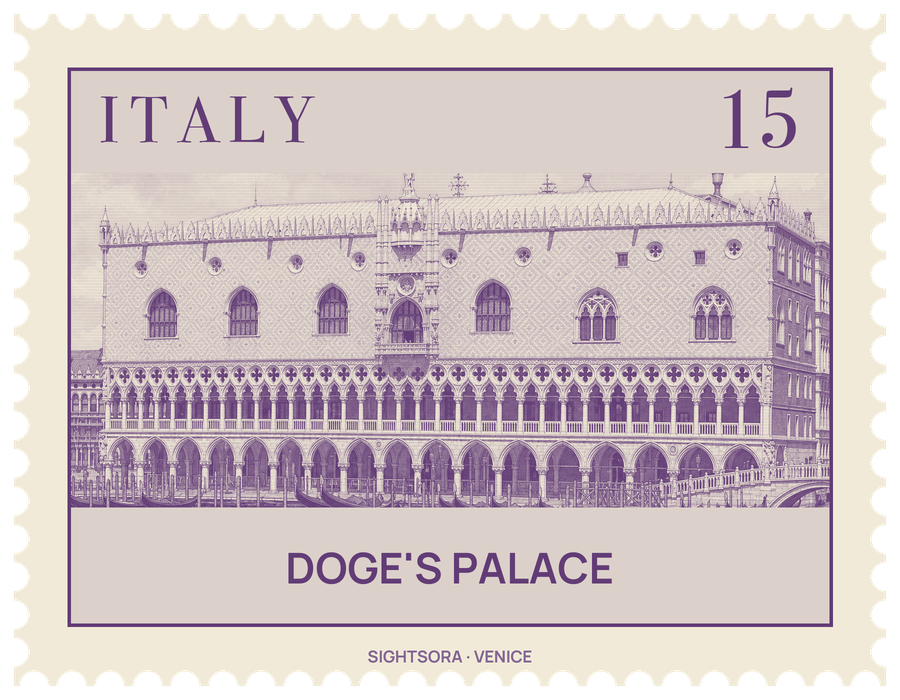
The Fondazione Musei Civici di Venezia, which runs it, calls the building a masterpiece of Gothic art and a symbol of Venice. One wing looks over the St. Mark's Basin and the other over the Piazzetta, and the palace has been a museum since 1923.
A ducal seat stood here from 810, but almost nothing survives of the early buildings, which were burned and rebuilt more than once. The Gothic palace seen from the lagoon side was begun around 1340, when the growing Great Council needed more room, and in 1424 Doge Francesco Foscari extended the work to the Piazzetta wing. Fires in 1483, 1574 and 1577 destroyed rooms and paintings by artists such as Bellini, Carpaccio and Titian; after the last one, Venice chose to rebuild in the original Gothic manner, setting aside designs by Andrea Palladio. The Republic governed from these rooms until 1797, when Napoleonic forces took Venice.
Visitors come in through the Porta del Frumento on the waterfront, while the old ceremonial gate, the Porta della Carta built by Giovanni and Bartolomeo Bon in 1438–1442, faces the Piazzetta under a statue of Justice holding sword and scales. In the courtyard, two well-heads from the mid-16th century stand in front of the Giants' Staircase, guarded since 1567 by Sansovino's colossal Mars and Neptune, symbols of Venetian power on land and at sea. The Museo dell'Opera shows, across six rooms, the original 14th- and 15th-century capitals taken down from the arcades during restoration that began in 1876 and replaced with copies.
The Doge's apartments in the northeast corner were rebuilt after the fire of 1483 and finished by 1510; they are modest in size, with carved and gilded ceilings and marble fireplaces, and each Doge filled them with furniture from his own house. Other rooms served the councils and the courts. In the Guariento Room hang the remains of a fresco Guariento painted around 1365 for the Great Council, rediscovered in 1903 behind Tintoretto's Paradiso after the 1577 fire had nearly wiped it out.
A visit also takes in the old prisons. The dark, damp cells on the ground floor were nicknamed the Pozzi, "the wells", and those under the lead roof the Piombi; Giacomo Casanova described escaping through that roof and walking out by the Porta della Carta. An enclosed bridge built shortly after 1600 crosses the Rio di Palazzo to the New Prisons. Its name, the Bridge of Sighs, came later, in the Romantic period, from the idea of prisoners taking a last look at the lagoon and San Giorgio Maggiore through its barred windows.