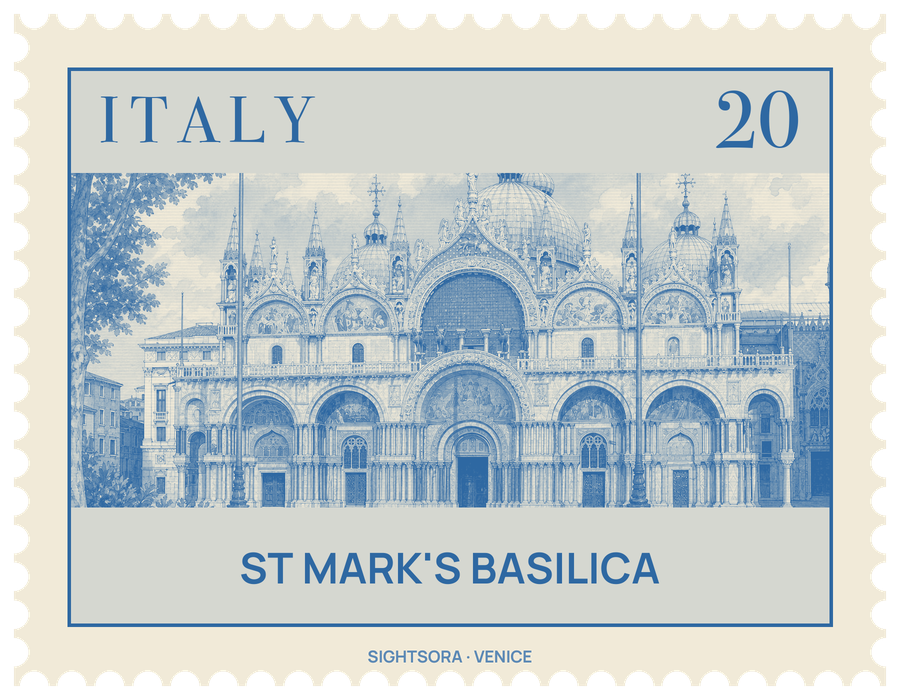
The church exists to house the body of the city's patron, Mark the Evangelist, which two Venetian merchants carried off from Alexandria in 828/829. Until the Republic fell in 1797 it was the Doge's own chapel rather than the city's cathedral; it became the seat of the Patriarch of Venice only in 1807.
The church seen today is the third on the site, most likely started in 1063, when Domenico I Contarini was Doge, and dedicated on 8 October 1094. Like the two earlier churches, it followed a Constantinople model, the Holy Apostles, with a cross-shaped plan and a dome over each arm, though the nave was stretched to suit the processions of Venetian state ceremony. In the 13th century the plain brick church was transformed: coloured columns, reliefs and sculptures stripped from Constantinople after the Fourth Crusade were fixed to its walls, and the low Byzantine domes were given tall wooden outer shells covered in lead and crowned with lanterns.
The western façade opens through five deep portals. Mosaics in the lunettes tell how the saint's body came to Venice; the one at the far left, showing the relics being placed in the church, is the only original from the 13th century, while the rest were remade later. Above runs a Gothic crest of pinnacles and statues from the late 14th and early 15th centuries, with a winged lion of Saint Mark over the central arch. The four gilded bronze horses on the balcony are copies: the originals, part of a team of four taken from the Hippodrome of Constantinople, have been kept inside since 1974. On the south side, facing the Doge's Palace, the carved pillars of Acre and the statue of the four tetrarchs are set into the walls.
The interior is dim, since many windows were walled up to make room for mosaic. Mosaics cover the domes, vaults and upper walls, telling the life of Christ along the main axis, with the Ascension in the central dome, Pentecost over the western arm and Immanuel above the high altar; they span about eight hundred years of styles, from Byzantine work to scenes drawn after designs by Titian, Tintoretto, Veronese, Paolo Uccello and Andrea del Castagno. The narthex has its own cycle from Genesis and Exodus, closely based on the Cotton Genesis manuscript. Underfoot, a floor of coloured marble and limestone laid in the late 11th or early 12th century mixes geometric patterns with lions, eagles, griffins and peacocks.
A Gothic altar screen of 1394 closes off the chancel, topped by statues of the Virgin, Saint Mark and the Twelve Apostles. Behind it, the high altar has held the relics of Saint Mark since 1835, beneath a ciborium on four carved columns, and its altarpiece is the Pala d'Oro, Byzantine enamels on gilded silver ordered from Constantinople in 1102. In the northern transept, the Madonna Nicopeia, a Byzantine icon venerated as the protector of Venice, has its own altar. The building's acoustics favoured the Venetian polychoral style, with separate choirs placed apart and singing in turn; Adrian Willaert brought it here as choirmaster from 1527, and later musicians of the basilica such as Claudio Monteverdi and the organist Giovanni Gabrieli spread it across Europe.