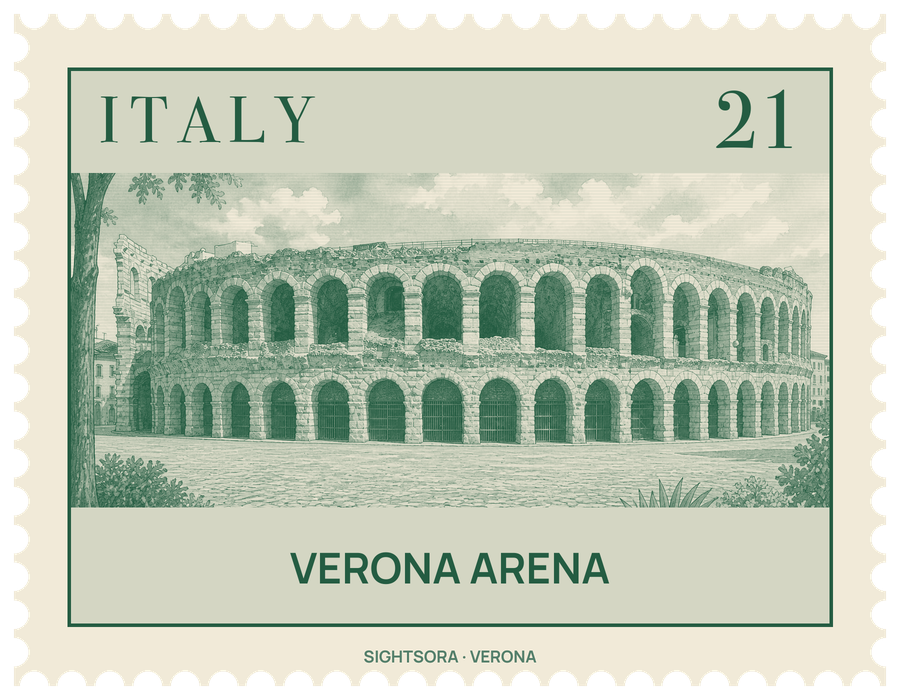
No written account of its construction survives, but the style of a carved gladiator's helmet found among its decorations points to completion around 30 AD, earlier than the Colosseum. It owes its good condition largely to restoration work that the city began in the 16th century.
The building went up just outside the Roman city walls, and in 265 Emperor Gallienus extended the defences with a new stretch of wall to enclose it. In 312, during the war between Constantine and Maxentius, the amphitheatre served the besieged defenders as a bastion, and a carved panel on the Arch of Constantine shows Verona under siege. Under Theodoric the Great much of the outer ring was pulled down for stone, and floods and the earthquake of January 3, 1117 caused further damage. In the Middle Ages the arcades were lived in and leased out while the inner cavea was kept closed; in 1278 nearly 200 Cathar heretics were burned at the stake inside.
The original monumental façade was an outer ring of three tiers of arches in red ammonitic limestone from Valpolicella, its blocks stacked without mortar and left rough. Only one piece of it still stands: the Ala, or wing, a section four arches wide, with entrance numbers LXIV to LXVII carved above its Tuscan capitals. Medieval legend claimed the Devil had raised the building in one night and fled at the morning Hail Mary, leaving the Ala unfinished. What visitors see as the outer wall today was originally the inner front, with 72 numbered arches running around it.
Inside, the oval arena floor is a round 250 by 150 Roman feet, and the whole structure reaches 152.43 by 123.23 metres. Three concentric galleries support the seating, and 64 staircases, the vomitoria, lead up through them to the tiers. The grandest entrance faces west towards Porta Borsari, with a central vault twice the height of the others, and the western sector was probably where the procession opening the games came in. Beneath the arena lies an underground chamber whose purpose is unknown. Statues unearthed during excavations are now in the city's Archaeological Museum at the Roman Theatre.
Over the centuries the Arena hosted jousts, plays, bull hunts and circus shows; Goethe admired it in September 1786, and Napoleon watched a bull hunt here in 1805. The first opera season was staged in 1856, and a performance of Aida in 1913 launched the summer festival. For summer performances the capacity is put at 22,000, with the stage taking up about a third of the seats; in Roman times it probably held around 30,000 spectators. Outside the festival season the amphitheatre is used for concerts.