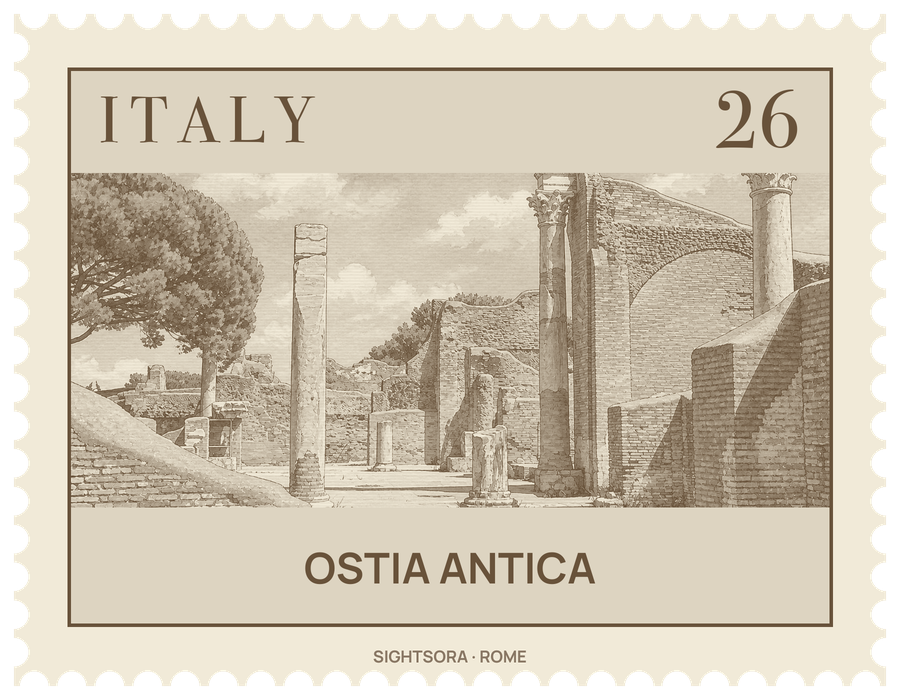
Silt carried by the river has since pushed the coastline back, leaving the ruins 3 km inland. After the town was abandoned, sand dunes covered it, which is why its streets, apartment blocks, frescoes and mosaics survived so well and why it shows everyday Roman urban life that the city of Rome itself no longer preserves.
Legend credits the colony to Ancus Marcius, the fourth king of Rome, and an inscription seems to place the first military camp, the castrum, in the 7th century BC, though the oldest visible buildings date from the 3rd century BC. Ostia served as a naval base and then as the port through which grain reached Rome. Pirates sacked it in 68 BC, after which it was given walls. Under the emperors it grew rich: Agrippa built the theatre, Claudius and later Trajan built the larger harbour at Portus to the north, and by the 2nd century AD the town is estimated to have held around 50,000 people.
The Forum lies at the heart of the old castrum, a long narrow square lined with porticoes, closed at one end by Hadrian's Capitolium, the temple of Jupiter, Juno and Minerva, and facing the temple of Rome and Augustus built under Tiberius at the other. The Basilica and the Curia open off its western side, and the Forum Baths, built under Antoninus Pius, stand to the south-east. The decumanus maximus, the main street on the line of the road from Rome, runs straight through it. Baths, taverns and inns were scattered across the town, and eighteen shrines of Mithras have been found here.
Much of Ostia was made up of apartment buildings several storeys high, with shops at street level, often behind porticoes, and stairs from the street up to cheaper flats above. Some shops had a mezzanine lit by a window over the door, where the merchant could live or store goods. Wealthier houses from late antiquity show how the town turned into a comfortable residential place: the Domus of Cupid and Psyche, from the 4th century, still has walls panelled in marble and floors of opus sectile around a small garden with a nymphaeum.
The ruins were used for centuries as a marble quarry for Rome's palazzi, and large-scale digs took place between 1939 and 1942. By one estimate, about two-thirds of ancient Ostia still lies unexcavated. The site is open to the public, and finds from the excavations are kept on site in the Museo Ostiense.