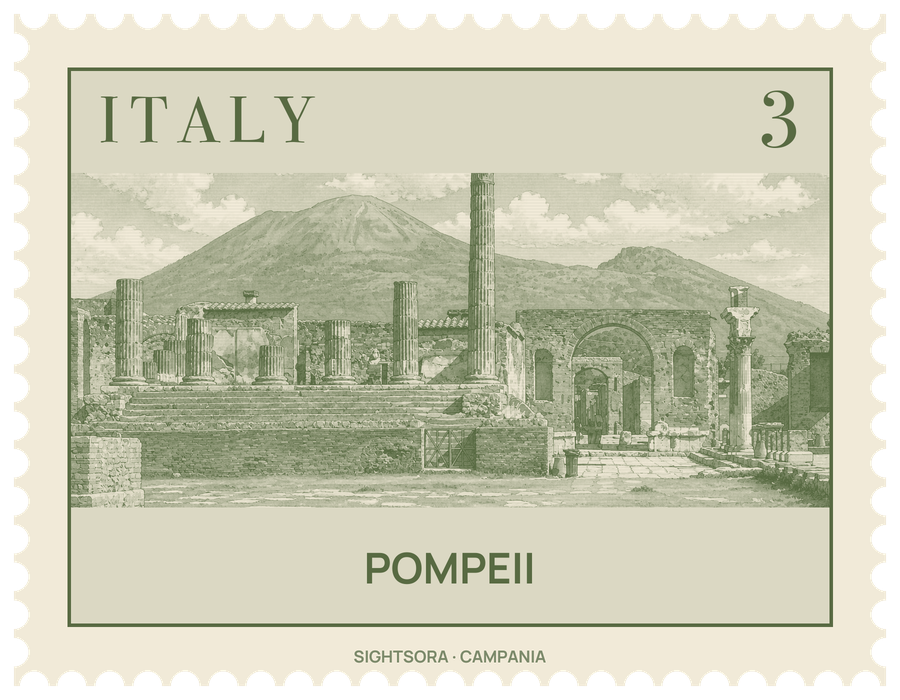
It lies beside the modern town of Pompei, near Naples in Campania, on a lava plateau about 8 km from the volcano; the ancient city, once by the shore, now stands roughly 700 m inland. The city covered some 64 to 67 hectares, about two-thirds of which have been dug out. UNESCO listed it as a World Heritage Site in 1997, and it lies within the larger Vesuvius National Park.
The town was much older than its Roman remains. Oscan villages stood here from the 8th century BC, and Greeks, Etruscans and Samnites all left their mark before Rome took control; after Pompeii sided against Rome in the Social Wars, Sulla besieged it in 89 BC, and the craters left by his ballista shots can still be seen in the walls near the Porta Ercolano. It became a Roman colony, and under Augustus it gained new public buildings and running water from a branch of the Serino Aqueduct. A severe earthquake on 5 February 62 damaged the city badly, and rebuilding was still going on when Vesuvius erupted.
The eruption lasted two days. A first phase of falling pumice, about 18 hours long, gave most people time to flee, and only about 1,150 bodies have been found on the site. Then pyroclastic flows of scorching ash swept over the town and killed those who remained, mostly through heat. Pliny the Younger watched from Misenum across the Bay of Naples and later described it, and his uncle Pliny the Elder died while leading the fleet to help. Bodies left hollows in the hardened ash; Giuseppe Fiorelli, who took charge of the excavations in 1863, worked out how to pour plaster into them, producing the casts that show victims in their final moments.
Fiorelli also divided the city into the nine regiones and numbered blocks and doorways still used today. Walking the excavated streets, visitors pass the Forum with the Temple of Jupiter and the Basilica, two theatres, the Amphitheatre with its palaestra and pool, the Stabian and other public baths, the Macellum market and the Lupanar. Among the houses are the House of the Faun, the House of the Tragic Poet and, outside the walls, the Villa of the Mysteries. Graffiti scratched on walls inside and out preserve the everyday spoken Latin of the time.
Ordinary trades show up everywhere. The town had at least 31 bakeries with ovens and millstones, and nearly 100 thermopolia, counters serving hot food and drink, such as that of Vetutius Placidus with its storage jars and painted shrine. The Building of Eumachia, put up by a priestess after 62, was the wool market or seat of the fullers' guild, and the fullonica of Stephanus shows tanks where cloth was washed. Many of the finest frescoes and objects from Pompeii are in the Naples National Archaeological Museum, while on site the Antiquarium, first built by Fiorelli in 1873–1874, displays finds, casts of victims and the story of the settlement before Roman times.