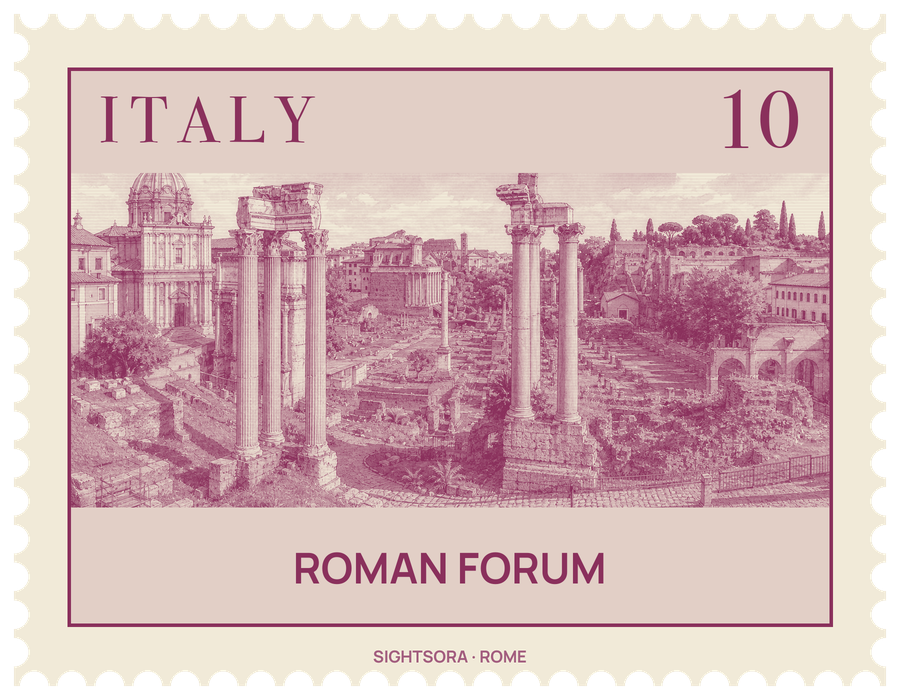
Romans called it the Forum Magnum, or simply the Forum. What survives is a scatter of columns, arches, temple platforms and paving around an open rectangle that by imperial times measured about 130 by 50 meters, running from the foot of the Capitoline towards the Velian Hill, while an extra area stretched on to the Arch of Titus in the southeast.
The valley began as marshy ground and was drained by the Cloaca Maxima, the great covered sewer that carried water off to the Tiber. Tradition placed the alliance between Romulus on the Palatine and Titus Tatius on the Capitoline here, and the Vulcanal shrine and the Comitium, the early assembly area at the northwest end, were credited to Romulus himself. The oldest religious buildings stood at the southeastern edge: the Regia, the early royal residence, the Temple of Vesta and the house of the Vestal Virgins, all later rebuilt.
As Rome grew, the Forum filled with temples and halls. The earliest temples with known dates are those of Saturn, from 497 BC, and of Castor and Pollux, from 484 BC; eight columns are all that remain of the Temple of Saturn, which also served as the state bank. Two great basilicas framed the long sides of the square, the Basilica Aemilia to the north and the Basilica Julia to the south, built by Julius Caesar along with the Curia Julia, the Senate House. After Caesar's murder in 44 BC his body was burned in the Forum, and Augustus built the Temple of Caesar on the spot. Paving laid under Augustus in travertine can still be seen.
Later emperors added their own landmarks. The white marble Arch of Septimius Severus, dedicated in 203 AD, rises at the northwest end near the Capitoline, and Diocletian rebuilt the Curia Julia, the Temple of Saturn and the Temple of Vesta. The Basilica of Maxentius, completed under Constantine in 312 AD, was the last major addition to the complex, and the Column of Phocas, set up in 608 in front of the Rostra, the speakers' platform, was the final monument raised here.
After Rome's fall the Forum slowly disappeared under debris and became the Campo Vaccino, the "cattle field". Its buildings were quarried for stone and burned for lime, worst of all under Pope Paul III in the 1540s for the new Saint Peter's Basilica. Clearing began in 1803 with Carlo Fea's work at the Arch of Septimius Severus, and state excavations started in 1898 under Giacomo Boni. The Via dei Fori Imperiali built in the Mussolini era separates the Forum from the Imperial Fora of Caesar, Augustus, Nerva and Trajan.