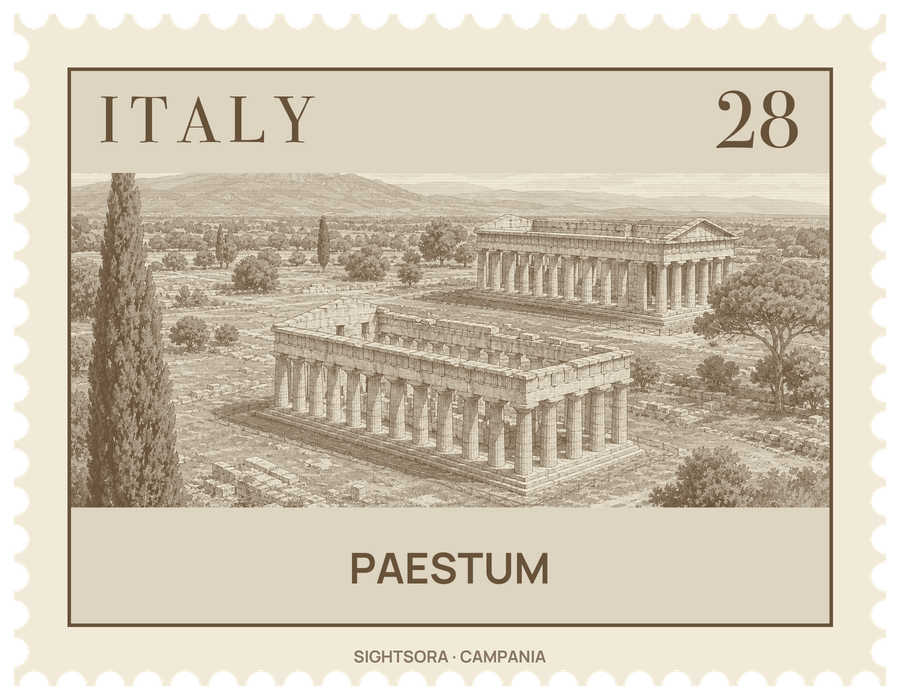
Settlers from Sybaris founded it around 600 BCE as Poseidonia; the Lucanians took it in 400 BCE, and in 273 BCE the Romans made it a Latin colony and gave it the name Paestum. Flooding and marshes brought decline, and after being abandoned in the Early Middle Ages it lay largely forgotten until the eighteenth century, when the temples drew wide attention and influenced early Greek Revival architecture.
The oldest of the temples, the first Temple of Hera, dates from around 550 BCE and stands at the southern end of the site. Eighteenth-century scholars thought it was a Roman building and called it "the Basilica". Its columns swell strongly along their length, some capitals keep traces of paint, and it has an unusual nine columns across each short end. Its neighbour immediately to the north, the second Temple of Hera, dates from around 460–450 BCE and was long attributed to Poseidon; it is the only one of the three that still carries most of its entablature, and two altars survive on its east side. On the highest point of the town, the Temple of Athena from around 500 BCE mixes Doric and Ionic features, and three medieval Christian tombs in its floor show it later served as a church.
Between the temples lies the rest of the city, cleared of modern buildings, with paved roads and the lower walls of many structures. The Roman Forum occupies the centre, probably on the site of the Greek agora, with a small temple of 200 BCE to Jupiter, Juno and Minerva on its north side. North-east of the forum is the amphitheatre, of which only the western half can be seen, because a road built across it in 1930 buried the rest. There is also a small round assembly space with tiered seats, and the heroön, a shrine to an unnamed hero, probably the city's founder. The polygonal circuit of city walls, typically 7 m high, remain largely intact, with gates such as Porta Sirena, Porta Giustizia and Porta Marina and a series of square and round towers.
The National Archaeological Museum of Paestum, inside the site, holds the finds. Its centrepiece is the earlier series of Archaic metope reliefs from the sanctuary of Hera at the mouth of the Sele river, telling the life of Heracles in 38 surviving panels, set around walls at their original height. The museum also shows the Tomb of the Diver of about 470 BCE, found on 3 June 1968: its lid shows a young man diving into water, while the four walls show a symposium; all five frescoes are displayed. Bronze vessels with traces of honey and a black-figure Athenian amphora from the heroön, painted terracotta from the temples and painted Lucanian tombs complete the collection.
Getting there
Trains on the line from Naples via Salerno to Reggio Calabria stop at Paestum station, which lies just outside the ancient walls on their east side. The modern village of Paestum, with its sandy beaches, lies directly south of the archaeological site.