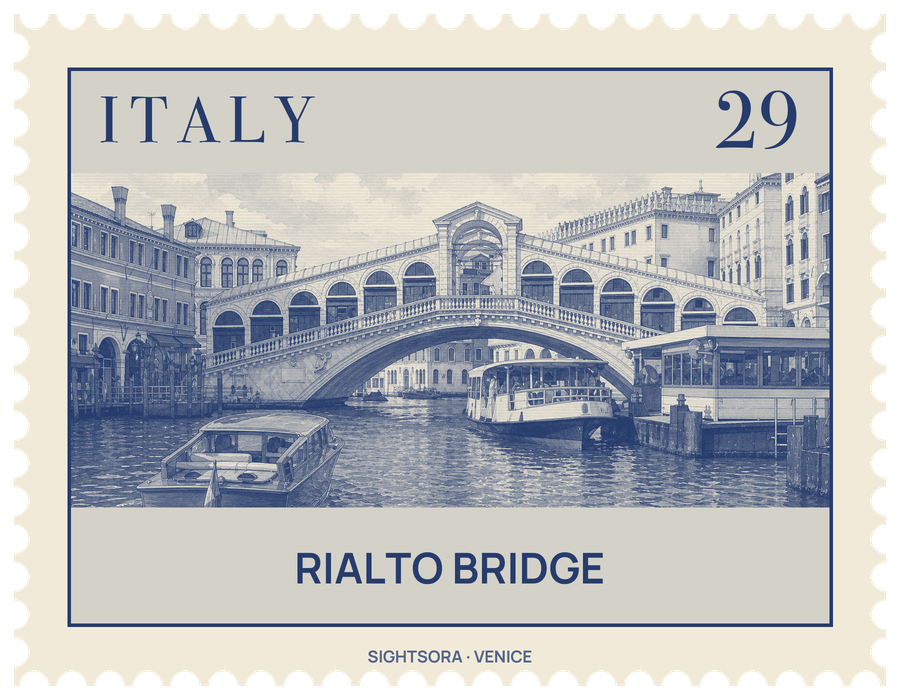
Antonio da Ponte designed it, and it was built between 1588 and 1591. Two ramps climb to a central portico, and along both sides of the ramps run covered arcades of shops. The design was thought so daring at the time that the architect Vincenzo Scamozzi predicted it would fail, yet it has stood ever since.
Before the stone bridge, the crossing was made first on a pontoon bridge, known as the Ponte della Moneta after a mint near its eastern end, and from 1255 on a wooden bridge. The timber bridge had a movable middle section that could be lifted for tall ships, and early in the 15th century shops were lined up along both its sides, their rents helping to pay for upkeep. It was partly burned during the revolt of Bajamonte Tiepolo in 1310, collapsed under a crowd in 1444 and fell again in 1524; the present stone bridge keeps much of its shape.
Rebuilding in stone was first proposed in 1503, and in 1551 the city asked for designs. Jacopo Sansovino, Palladio and Vignola all offered classical schemes with several arches, which were judged unsuitable for the site, and Michelangelo was also considered before the commission went to da Ponte. The market's importance gave the bridge its name, and Robert Browning called it Shylock's bridge, after the line in The Merchant of Venice in which Shylock recalls being rated "in the Rialto".