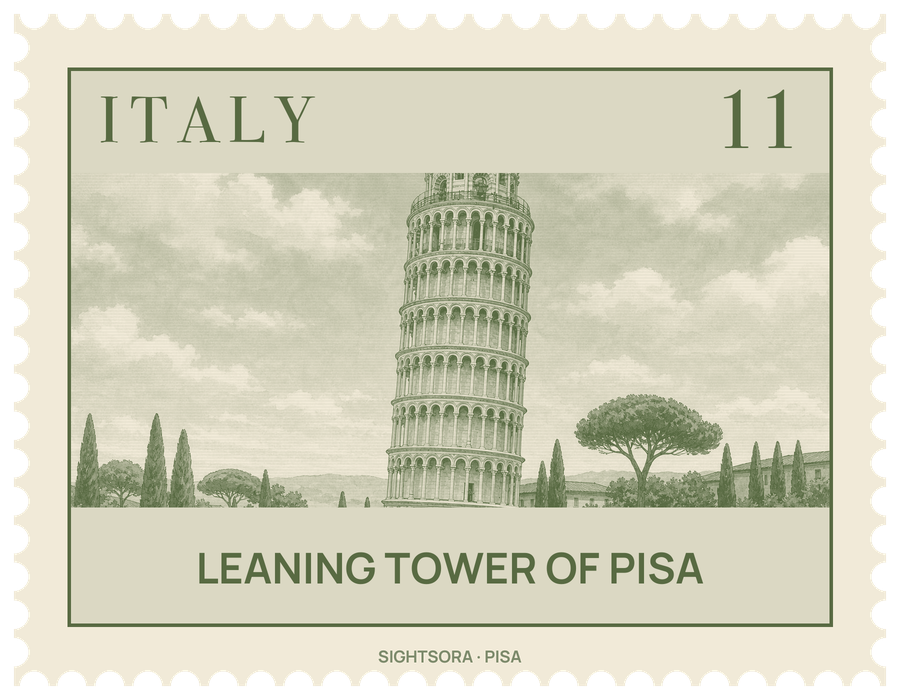
Although it is called a tower, the Opera della Primaziale Pisana points out that it never had any role in defending the city. It belongs to the group of religious buildings on the Piazza del Duomo, also called the Piazza dei Miracoli, alongside the cathedral and the baptistery, and in 1987 the square with its cemetery was inscribed as a UNESCO World Heritage Site.
The foundations were laid on 9 August 1173, and by 1178, with work only up to the second floor, the tower had started to sink. Its footing was just three metres deep in soft, unstable ground. Pisa's wars with Genoa, Lucca and Florence then stopped building for most of a century, which gave the soil time to settle. When Giovanni di Simone took up the work again in 1272, the builders tried to correct the lean by making the upper storeys taller on one side, which is why the tower has a slight curve. The seventh floor was finished in 1319, and Tommaso di Andrea Pisano completed the bell chamber in 1372, blending its Gothic details with the Romanesque storeys below.
The ground floor is a blind arcade of engaged columns with Corinthian capitals, and the official count of capitals on the whole tower is 207. At the top hang seven bells, matching the seven notes of the scale; they once marked the hours of the day and of worship; the largest weighs about three and a half tonnes. The crowning belfry was built with a small correction of 14 cm to offset the tilt beneath it, and the tower itself sits slightly off the line formed by the cathedral and baptistery.
Several stories attach to the tower. Galileo Galilei, who lived in Pisa, reportedly let two cannonballs of unequal mass fall from it between 1589 and 1592, showing that both reached the ground together. During World War II an Army sergeant, Leon Weckstein, sent to check whether German troops were using it as a lookout, held back from calling in artillery fire.
By 1990 the lean had reached 5.5 degrees, and on 7 January that year the doors were shut to visitors. The bells were taken down, cables were tied around the third level, and from 1993 some 870 tonnes of lead counterweights were added. Engineers then drew 38 cubic metres of soil from beneath the raised side, bringing the top back by 45 centimetres to where it had stood in 1838, and the tower reopened on 15 December 2001. The same soft ground that made it lean has also helped it ride out at least four strong earthquakes since 1280, because the tower does not resonate with the shaking.