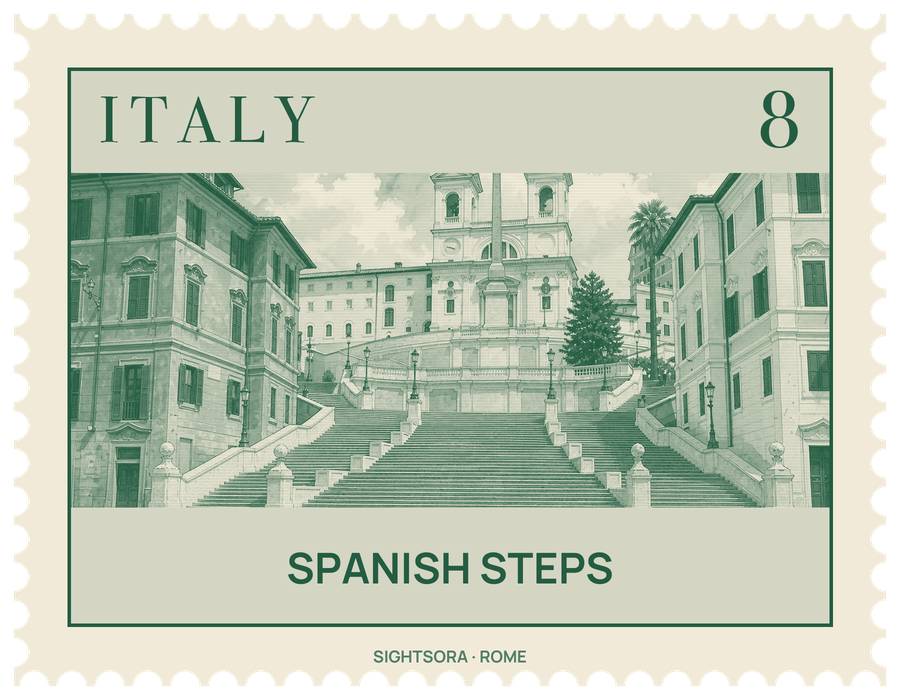
In Italian they are the Scalinata di Trinità dei Monti; the English name comes from the square below, where the Spanish Embassy to the Holy See occupies the Palazzo Monaldeschi, while the church above stood under French royal patronage, that of the Bourbons.
Plans to link the church with the square below went back to the 1580s, when Pope Gregory XIII showed interest in a stair. A French diplomat, Étienne Gueffier, left money for the job when he died in 1660, but the scheme stalled over a proposal to add a statue of Louis XIV on horseback, which angered papal Rome, and over a contested will. Pope Clement XI revived it, and Francesco de Sanctis took first place in a 1717 competition, although the winning design was long attributed to Alessandro Specchi.
The design takes the divided, symmetrical stairs of terraced gardens and blows them up to the scale of a hillside. Sculpted details balance the French Bourbon fleur-de-lys with the eagle and crown of Pope Innocent XIII. The travertine has needed repeated repair; a restoration sponsored by Bulgari ran from October 2015 to September 2016.
At the foot of the steps is the Fontana della Barcaccia, the "Fountain of the longboat", an Early Baroque work of 1627–29 usually attributed to Pietro Bernini, whose son was Gian Lorenzo Bernini. Legend says Pope Urban VIII commissioned it after a Tiber flood carried a boat into the square. On the right as one starts climbing is the house where John Keats, the English poet, lived until his death in 1821, now a museum to him and his Romantic circle. From the top of the steps visitors can walk on to the Villa Medici.
The steps change with the calendar. At Christmas a 19th-century nativity scene is set up on the first landing, and in spring, around the anniversary of Rome's founding on 21 April, pots of azaleas cover part of the stairway into early May. They appear in films including Roman Holiday and The Talented Mr. Ripley.