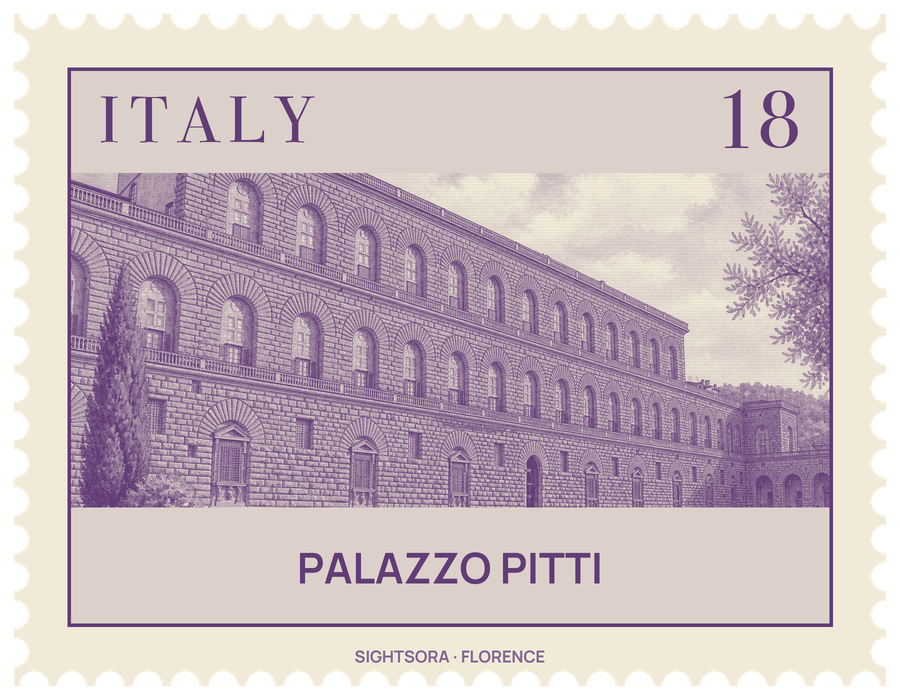
The Florentine banker Luca Pitti had it built in the mid-15th century, and his name stayed with it after the Medici Duke Cosimo I and Eleonora of Toledo, his wife, bought it to be the new grand-ducal residence. Three dynasties lived here in turn: the Medici, then the Habsburg-Lorraine from 1737, and finally the House of Savoy as kings of Italy. Victor Emmanuel III gave the palace and its contents to the nation in 1919, and it is part of the Historic Centre of Florence UNESCO site.
The original block, with its rows of seven arched openings, was more than doubled in size once the Medici moved in. Bartolommeo Ammanati added the courtyard behind the façade, whose heavy banded stonework was widely imitated, and a grotto with a porphyry statue of Moses that opens towards the Boboli Gardens laid out behind the palace. Giorgio Vasari built the raised corridor that let the Grand Duke walk from the Palazzo Vecchio through the Uffizi and over the Ponte Vecchio to his new home.
Today the palace holds five museums on three levels. The Galleria Palatina and the royal apartments fill the piano nobile; the Gallery of Modern Art and the Museum of Fashion and Costume take the second floor; and on the ground floor are the Treasury of the Grand Dukes, the Museum of Russian Icons and the Palatine Chapel. The Galleria Palatina keeps the feel of a princely house, with over 500 paintings hung in the grand rooms they were meant for rather than in historical order. Its stars include Raphael's Madonna della Seggiola and La Velata, Titian's La Bella and Rubens's Consequences of War, and Pietro da Cortona decorated the ceilings of its five Planetary Rooms, named after Venus, Apollo, Mars, Jupiter and Saturn.
The royal apartments, redecorated by the Savoy kings, include a throne room hung with red brocade and smaller rooms with Medici portraits by Justus Sustermans. Upstairs, the Gallery of Modern Art covers Italian painting up to the early 20th century, notably the Tuscan Macchiaioli led by Giovanni Fattori, while the costume museum shows clothes from the 16th century onwards, including the funeral garments of Cosimo I and Eleonora of Toledo. The Treasury, the old summer apartment of the Medici, displays silverware, ivories, cameos and the hardstone vases collected by Lorenzo de' Medici.
The entrance from Piazza Pitti climbs a slope of about 20 per cent, and lifts on the right of the courtyard serve the first and second floors.