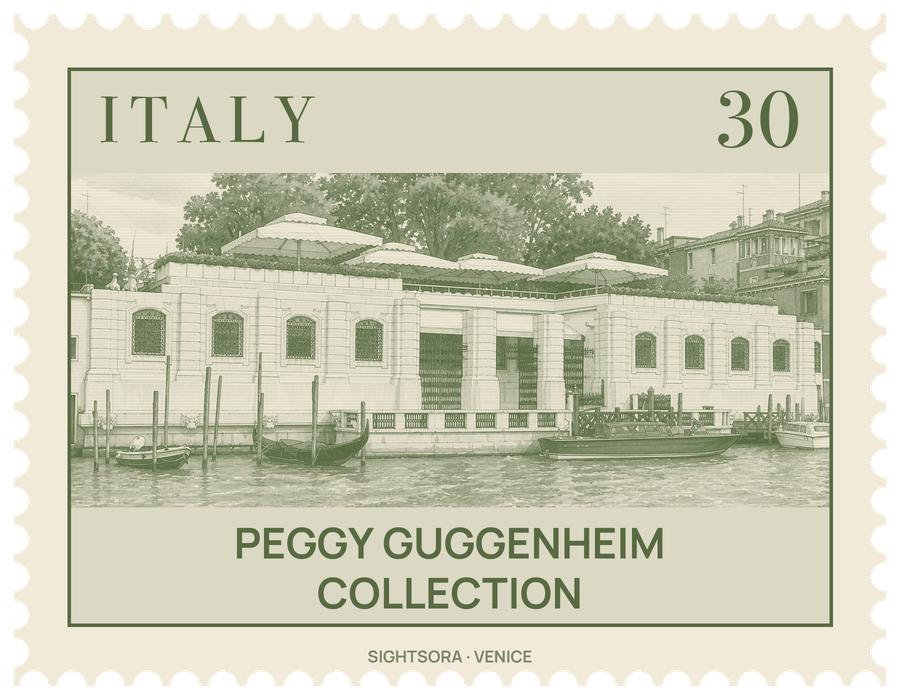
The American collector Peggy Guggenheim bought the palace in 1949, lived there for thirty years and from 1951 opened her home and collection to the public in the summer months. In 1976 she donated the palace and her collection of some 300 works to the Solomon R. Guggenheim Foundation, and after her death in 1979 the foundation reopened it in April 1980 as a museum.
The building is often taken for a modern one, but it is an 18th-century palace by the Venetian architect Lorenzo Boschetti that was never finished, which is why its façade rises so little above the canal. Its low front interrupts the row of grand palaces lining the canal from the Accademia to the Salute. Behind it, the Nasher Sculpture Garden holds sculpture among the trees, and Peggy Guggenheim's ashes rest in the gardens of the palazzo. Over the years the museum has expanded into neighbouring properties, adding galleries, a shop and a café.
Peggy Guggenheim, a niece of Solomon R. Guggenheim and once married to Max Ernst, assembled most of the collection between 1938 and 1946, buying in Europe at the outbreak of World War II and afterwards in America; there she recognised the talent of Jackson Pollock. On the walls are works such as Giorgio de Chirico's The Red Tower, Picasso's The Poet and On the Beach, Georges Braque's The Clarinet, Marcel Duchamp's Sad Young Man on a Train, Salvador Dalí's Birth of Liquid Desires, René Magritte's Empire of Light and Paul Klee's Magic Garden. Sculpture includes a piece from Constantin Brâncuși's Bird in Space series and Alberto Giacometti's Woman Walking, while Alexander Calder's Arc of Petals and Pollock's The Moon Woman and Alchemy represent American art. One room shows paintings by her daughter, Pegeen Vail Guggenheim.
Alongside the permanent collection, the Gianni Mattioli Collection lends the museum 26 works on a long-term basis, with images of Italian futurism such as Umberto Boccioni's Dynamism of a Cyclist, Carlo Carrà's Interventionist Demonstration and Luigi Russolo's The Solidity of Fog. Rudolph and Hannelore Schulhof's collection added 83 works in 2012, shown in a gallery of their own. The Solomon R. Guggenheim Foundation also runs the United States pavilion at the Venice Biennale, a Palladian-style building of 1930 that it bought in 1986.