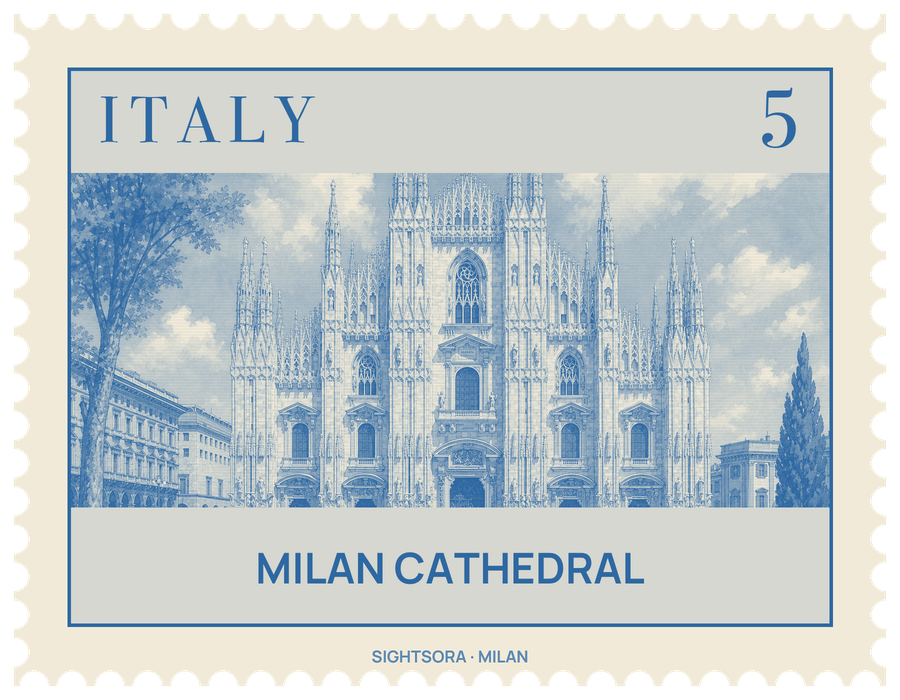
It is dedicated to the Nativity of Mary, Santa Maria Nascente, and the Archbishop of Milan has his seat here; the Veneranda Fabbrica del Duomo looks after it. Building it took nearly six centuries, from 1386, when Archbishop Antonio da Saluzzo started work, to 6 January 1965, when the last portal was inaugurated.
The project grew with the ambitions of Gian Galeazzo Visconti, who granted the Fabbrica del Duomo exclusive rights to Candoglia marble. French engineers were brought in, first Nicolas de Bonaventure in 1389 and then Jean Mignot, who warned that the work was in "peril of ruin"; it was not, but the warning pushed the builders to improve their methods. By Gian Galeazzo's death in 1402 almost half the church stood, and between 1500 and 1510 the octagonal cupola was completed. Carlo Borromeo consecrated the building in 1577, and in 1762 the spire of the Madonnina rose to 108.5 m, topped by the polychrome Madonnina statue; in this misty climate, the Milanese call it a fine day when she can be seen from afar. The façade was only finished after Napoleon ordered it in 1805, and he was crowned King of Italy here.
Inside, the space is divided into five broad naves by 40 pillars, with a transept that has aisles of its own, a choir and an apse. The nave rises to about 45 metres on columns 24.5 metres tall, and the apse windows measure 20.7 by 8.5 metres. Near the altar on the left is Marco d'Agrate's Saint Bartholomew Flayed of 1562, the saint wearing his own skin across his shoulders like a stole. The transepts hold the Trivulzio Candelabrum, whose 12th-century base is a tangle of vines and imaginary animals, and the right transept has Leone Leoni's monument to Gian Giacomo Medici, known as Medeghino. A small red light in the vault above the apse marks where a nail said to come from the Crucifixion is kept; every year it is taken down and shown to the public in the Rite of the Nivola.
Near the west end, a brass meridian line runs across the floor and climbs the north wall. It was laid out with the Brera astronomers after 1786: sunlight falling through a hole 24 metres up in the roof crossed the line at solar noon, a signal was passed to the Sforzesco Castle and a cannon fired so the city could set its clocks. Below the cathedral, visitors can see the old octagonal baptistery of 335, the Battistero Paleocristiano, and the crypt holds the relics of Saint Charles Borromeo. In November and December, in the days around his birthdate, the large canvases called the Quadroni hang along the nave.
Visitors can go up onto the roof, where the openwork pinnacles and spires stand on slender flying buttresses and much of the sculpture can be seen at close range; the building has 135 spires in all. Reactions to the mixed styles have long been divided: John Ruskin attacked them, Henry James called the cathedral "grandly curious and superbly rich", and Mark Twain devoted a chapter of Innocents Abroad to the building and its roof.